Author: Sahil

  • Inventory Turnover Ratio of Food Wholesalers Formula, Calculator & Benchmarks

    Inventory turnover ratio is the number of times your business sells and replaces its inventory during a period. The formula for food wholesalers is: Inventory Turnover Ratio = Cost of Goods Sold (COGS) / Average Inventory Getting this number right is the difference between fresh, profitable stock and a warehouse of write-offs.
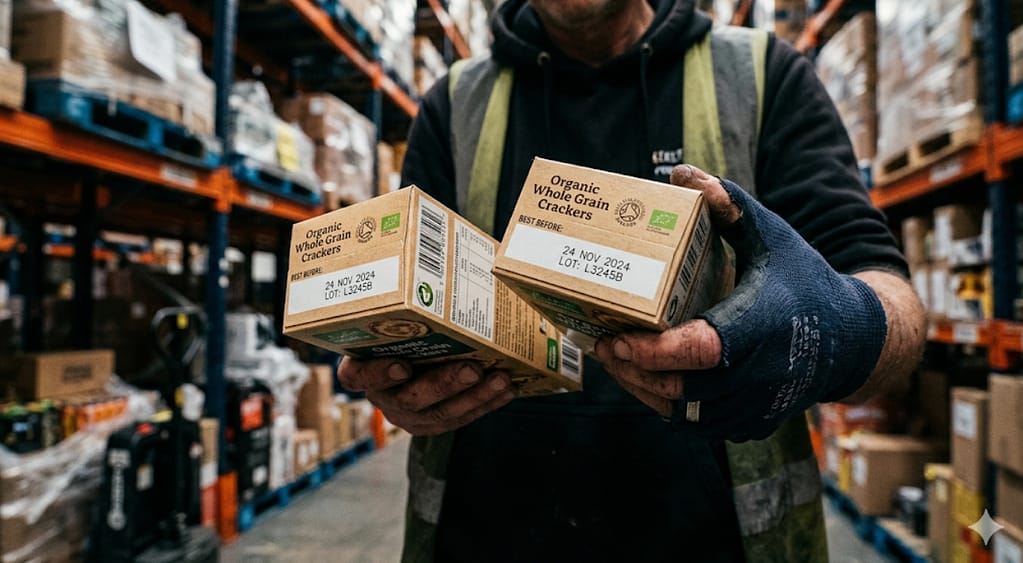
    Table of Contents

    What is the Inventory Turnover Ratio?

    Inventory turnover ratio is a measure of how many times a business sells and replaces its inventory during a certain period of time, often a fiscal year. A high ratio means the stock is faster, less expensive to hold and has more cash flow. A low ratio suggests overstocking, slow demand or poor buying decisions.

    For food wholesalers and distributors, this metric carries even more weight than it does in general retail. Slow-moving stock does not just tie up capital. It spoils, expires, and generates write-offs that eat directly into margins. Understanding and actively managing your inventory turnover ratio is foundational to running a profitable food distribution operation.

    This metric is even more important to food wholesalers and distributors than it is to general retail. Downward stock doesn’t just tie up capital. It goes bad, it goes stale, it causes write-offs that eat into margins. Knowing Inventory Turnover Equation inventory turnover ratio is the foundation of a successful food distribution business.

    Inventory Turnover Ratio = Cost of Goods Sold (COGS) / Average Inventory

    COGS is the direct cost of purchasing the goods you sell. It is the cost you pay to your suppliers for the products going out of your warehouse. Average Inventory smooths out fluctuations over the period. Average Inventory is calculated as:

    Average Inventory = (Opening Stock + Closing Stock) / 2

    So if your opening inventory value is $300,000 and your closing inventory value is $500,000, your Average Inventory is $400,000.

    Alternative Formula Using Net Sales

    Some businesses calculate inventory turnover using Net Sales rather than COGS:

    Average Inventory / Net Sales = Inventory Turnover Ratio

    This version is more typical of retail situations where COGS figures are not easily segregated from overheads, or of companies that use revenue figures to monitor performance. The COGS based formula is generally preferred for food wholesaling because it removes profit margins, giving a cleaner picture of how efficiently you are moving product through the supply chain. Only use the Net Sales version where COGS data is not available or for benchmarking to industry peers who report on a Net Sales basis.

    How to Calculate Inventory Turnover Ratio: Step-by-Step

    Step 1: Determine your COGS

    Remove the Cost of goods sold from your profit and loss statement for the period you are measuring. This is the total cost of goods sold for the period, not your total purchases. Most accounting systems (QuickBooks, Xero, MYOB) will report this directly. This is your COGS number for a fiscal year.

    Step 2: Locate Average Inventory

    Take the value of your inventory at the start of the period (Opening Stock) and at the end of the period (Closing Stock). Mix them and divide with 2. If your warehouse system is capable of real-time inventory tracking, you can also average the monthly closing balances to get a more accurate figure over the course of a full year.

    3. COGS divided by Avg. Inventory

    Apply the formula. Divide your Cost of Goods Sold total by your Average Inventory value. What you are calculating is your inventory turnover ratio (ITR), a number that indicates the number of complete stock cycles you have run through your business in that time frame.

    Step 4: Interpret the Result

    Context matters. A ratio of 6 means you sold out and restocked 6 times in the year, or roughly every two months. Whether that is good or bad is entirely dependent on your product category. Here is a real food wholesale figure worked example
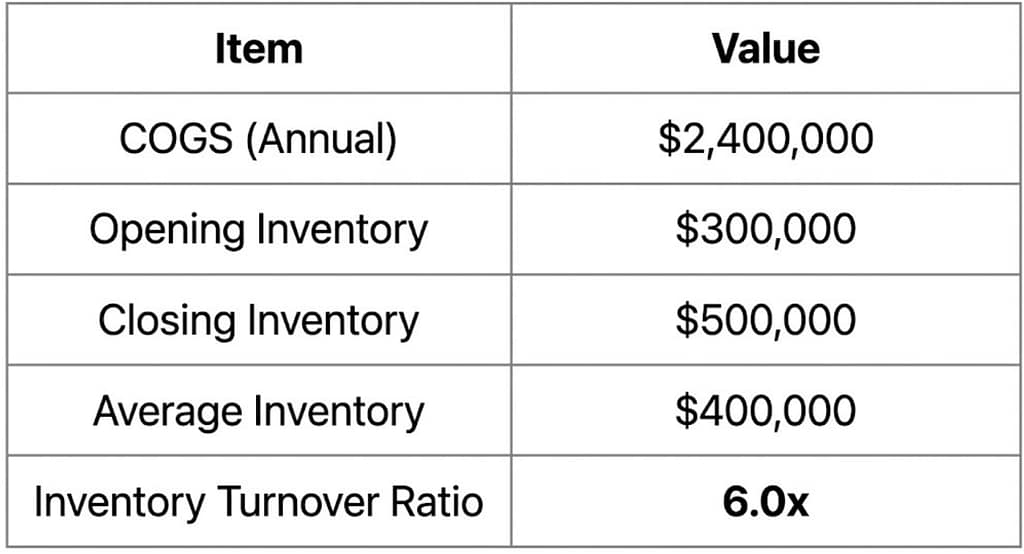
    A ratio of 6.0x means this business is turning its stock every 60 days on average. For a dry goods wholesaler, this sits within an acceptable range. For a fresh produce distributor, it would signal a serious problem.

    Inventory Turnover Ratio Calculator

    To calculate your own ratio, you need three inputs: your COGS for the period, your Opening Inventory value, and your Closing Inventory value. Enter these into the fields below and the calculator will return your Inventory Turnover Ratio along with an interpretation based on food wholesale benchmarks.

    Calculator Fields:

    • COGS ($)
    • Opening Inventory ($)
    • Closing Inventory ($)

    Output: Inventory Turnover Ratio + interpretation against food wholesale benchmarks

    If you want to see how AI-powered inventory management can directly improve the number you just calculated, explore OrderIT by Prosessed AI, built specifically for food distributors managing complex, perishable stock.

    What is a Good Inventory Turnover Ratio?

    Inventory Turnover Benchmarks by Industry

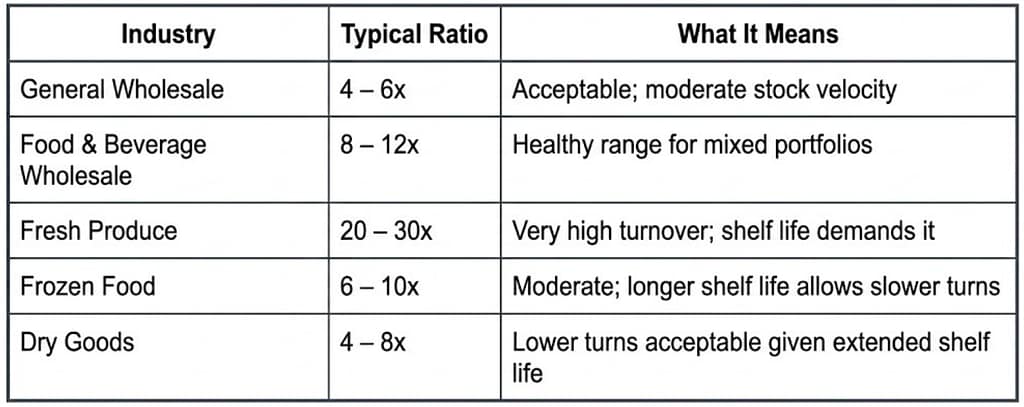
    Once you have your ratio, the next question is whether it is good, acceptable, or a warning sign. Benchmarks vary significantly by product category, which is why food wholesale operations cannot rely on general commerce benchmarks.These are directional benchmarks. Your actual target ratio should account for your specific product mix, supplier lead times, and customer order patterns.
    What Is Inventory Turnover Rate?

    A low inventory turnover ratio shows that stock is not moving as fast as it should. The consequences for food wholesaling are grim. Slow moving products through your warehouse take longer than their shelf life allows creating spoilage risk and expiry write-offs. Money is tied up in inventory that is not generating revenue, storage and handling costs are accruing, and refrigeration or climate-controlled space is being consumed by product that should have been shipped already. A low ratio is often indicative of overstocking due to inaccurate demand forecasting, poor alignment with suppliers or a product assortment containing SKUs in declining customer demand.

    What is a High Inventory Turnover?

    A high inventory turnover ratio is usually a good sign. It means that your operation is running smoothly, stock is moving fast and cash is not being tied up in your warehouse. For food businesses handling perishables, a high turnover ratio is not aspirational but a necessity. But a ratio that is too high can create problems of its own. Consistently turning stock faster than you can keep up with your reorder cycle puts you at risk for stockouts, missed sales, and customer frustration. You want a ratio that indicates that your stock is being well managed and is not creating supply gaps.

    Days Inventory Outstanding (DIO) is the companion metric to inventory turnover and one that food wholesalers should track alongside the ratio itself.

    DIO = 365 / Inventory Turnover Ratio

    Using the worked example above, a turnover ratio of 6.0x gives a DIO of approximately 61 days. This tells you that it takes your business 61 days, on average, to sell through its inventory.

    For food businesses, DIO has a very practical application. If your DIO exceeds the shelf life of your products, you have a structural problem. A fresh produce distributor with a DIO of 25 days and products that expire in 14 days is, by definition, generating waste. DIO brings the inventory turnover ratio down to a concrete, operationally actionable number that can be compared directly against product shelf life data.

    How to Improve Inventory Turnover in Food Wholesale

    1. Adopt AI-Driven Demand Forecasting

    The most common cause of poor inventory turnover in food distribution is overstocking, which is almost always due to poor demand forecasting. When buying decisions are driven by intuition, historical averages or manual spreadsheet models, the result is buying too much of the wrong products, at the wrong time. AI powered demand forecasting analysis of actual order history, seasonal patterns and buyer behaviour to provide accurate purchase recommendations before you place a supplier order. Prosessed AI’s OrderIT uses this approach to help food distributors reduce overstock by 15 to 20 percent, directly improving turnover ratios. You can also read more on this topic in our guide to demand forecasting for food wholesalers.

    2. Use FEFO (First Expired, First Out) Fulfilment

    FEFO is the fulfilment standard for any business managing products with expiry dates. Unlike FIFO (First In, First Out), which prioritises dispatch order by arrival date, FEFO ensures that the product closest to its expiry date always ships first, regardless of when it arrived. If you don’t have FEFO batch tracking, then warehouse teams will pick the stock that’s most accessible and this can mean that older product sits there until expiry. To implement FEFO in your warehouse, you need to track inventory at the batch level and tie expiry dates to pick sequences. For a comparison of fulfilment methods, see our related page FIFO vs LIFO for food distributors (coming soon).

    3. Detect and Liquidate Slow-Moving SKUs

    In every food wholesale business there are SKUs that slow down the average portfolio turnover. Those slow moving lines are typically hidden deep within the aggregate reporting and only appear when you drill down to SKU-level inventory performance. A review of slow-moving products should routinely identify products whose DIO numbers are greater than the shelf life, SKUs not sold within a defined period, and lines with stock on hand that is significantly greater than expected demand. Once identified, slow movers must be dealt with through promotional pricing, liquidation into secondary markets or removal from the active catalogue, so as to release warehouse space and purchasing capacity.

    4. Reorder Points Tightened with Real-Time Inventory Info

    Static calculations or monthly stock counts will always lag behind actual demand and reorder points. If your procurement team is relying on inventory data that is even a few days old, they are making buying decisions based on an inaccurate picture of what is actually in the warehouse. This is completely changed by real-time inventory visibility. If your re-order points are connected to live stock levels, orders are triggered at exactly the right time, reducing both stockouts and overstock situations. Prosessed AI’s OrderIT platform provides real-time inventory tracking that feeds directly into reorder logic, ensuring your purchasing decisions are always based on current stock reality rather than outdated snapshots.

    5. Align Procurement Cycles to Actual Demand

    Many food wholesalers operate to a fixed procurement cycle, putting purchase orders out on a weekly or monthly basis on a schedule rather than in response to what the market is doing. If demand from customers varies with the seasons, or by product category or even by external events, then a fixed cycle of procurement means you are always buying too much at slow times and too little at peak times. You need to link the buying decision to real sales velocity data to align your procurement cycle to demand signals. ProcurePro by Prosessed AI is built for exactly this, enabling demand-driven procurement that adjusts purchasing frequency and volume based on what your customers are actually ordering, rather than a calendar-driven rhythm.

    Frequently Asked Questions

    The formula for inventory turnover ratio is:

    The standard formula for the inventory turnover ratio is as follows: Inventory Turnover Ratio = Cost of Goods Sold (COGS) / Average Inventory. Average Inventory = (Opening Stock + Closing Stock)/2; In some businesses, Net Sales can substitute COGS, but for food wholesale businesses, the COGS formula is a better indicator of operational stock efficiency.

    What is a good inventory turnover ratio for food distributors?

    For general food and beverage wholesale, an 8 to 12x ratio is healthy. Fresh produce distributors should be targeting 20 to 30x for the very short shelf life of their products. Frozen food operations typically run in the 6 to 10x range, while dry goods distributors are usually in the 4 to 8x range. The right benchmark depends on your unique product mix and shelf life properties of your inventory.

    How frequently should I calculate inventory turnover?

    Most businesses calculate inventory turnover on an annual basis for financial reporting purposes, but food wholesalers benefit from calculating it monthly or even weekly for high-velocity product categories. Tracking the ratio at a shorter frequency allows you to identify deteriorating stock performance before it becomes a spoilage or cash flow problem.

    What is the difference between inventory turnover and days sales of inventory?

    Inventory turnover (or inventory turns) measures how many times you sell through your stock in a period, expressed as a multiple (e.g., 8x). Days Sales of Inventory (DSI), also known as Days Inventory Outstanding (DIO), converts that multiple into days and tells you how long it takes to sell through your average inventory level. DIO = 365 / Inventory Turnover Ratio. Both metrics measure the same underlying dynamic, but DSI is often more intuitive for operational teams because it can be compared directly against product shelf life.

    How does AI improve inventory turnover?

    AI improves inventory turnover by eliminating the inaccuracy that causes most turnover problems in the first place. AI-powered demand forecasting uses historical order data, customer buying patterns, and seasonal signals to generate precise purchase recommendations, preventing both overstock (which slows turnover) and understock (which causes missed sales). AI also enables real-time inventory monitoring that triggers reorders at exactly the right moment, and batch-level tracking that enforces FEFO dispatch to minimise expiry write-offs. The result is a tighter, faster-moving inventory with less waste and better cash performance.

    How Prosessed AI Helps Food Wholesalers Optimise Inventory Turnover

    Inventory turnover is not a metric you improve by watching a dashboard. It improves when the decisions that feed it change. Prosessed AI gives food wholesalers the tools to make better decisions at every point in the inventory cycle.

    OrderIT’s AI demand forecasting looks at your real order history and customer behaviour to make purchase recommendations that reduce overstock by 15 to 20 percent, one of the most direct levers to improve your turnover ratio. Batch-level tracking and FEFO enforcement (first expired, first out) ensures that product that is closest to its expiration date ships first. This helps to reduce write-offs that artificially inflate your average inventory value without contributing to COGS. Real-time inventory visibility means your reorder points are connected to live stock data, not a snapshot from last week’s count. ProcurePro synchronises your procurement cycles to actual demand, so that your buying decisions are driven by what your customers are ordering, not by a calendar.

    This results in higher stock velocity, lower carrying costs, and an inventory turnover ratio that will reflect a truly efficient operation.
    See OrderIT in Action

  • Best Software for Food Wholesalers and Distributors

    Running a food wholesale business means dealing with chaos every single day. Juggling items that spoil quickly sits alongside wild price swings from suppliers. Orders come in different currencies, while customers send messages through WhatsApp without warning. Sales teams stick to old spreadsheet habits instead of modern tools. Mistakes creep in easily when systems barely hold together. Wasted time turns into lost money quicker than expected.

    Midnight rolls around faster when you are stuck typing instead of clicking. Firms tracking orders by hand face paperwork loads forty to fifty percent heavier compared to teams running on tailored tools. Gains pile up elsewhere – think client growth, sharper pricing talks, or simply shutting down work earlier. What eats hours one day adds up to lost chances over weeks.

    Here’s the catch: plenty of programs labeled for wholesale trade actually ignore food needs. Instead of handling spoilage right, standard stock apps fall short. Even strong ERPs demand endless setup time along with sky-high fees. Most setups also expect buyers to order online – forgetting how many still send voice messages via chat.

    This guide walks through seven top tools built for food wholesalers in 2026 – spelling out which teams benefit most, yet where each one falls short. While some fit big distributors well, others suit small operations better; not every platform delivers equally across the board. Each option shows strengths, though specific needs shape whether it clicks or misses entirely.

    Table of Contents:

    1. What to Look For in Food Wholesale Software
    2. The 7 Best Software for Food Wholesalers (2026)
    3. Head-to-Head Comparison Table
    4. How to Choose the Right Software for Your Business Size
    5. FAQs
    6. The Bottom Line

    What to Look For in Food Wholesale Software

    Most wholesale systems aren’t made for how food moves out the door. When trucks are loading at 6 AM, small flaws in the software start screaming for attention. Knowing which features matter most makes it easier to tell them apart before things get hectic.

    AI-powered order management is no longer a premium feature.Top systems in 2026 create bills automatically, recommend how much to restock, catch odd prices, while also pulling orders straight from WhatsApp chats. Without built-in smart features, you’ll end up patching gaps with extra steps.

    Food-specific workflows matter more than you might expect. Food importers need tools that handle batch details, track expiration dates, manage variable weights on invoices, while also monitoring stock inside containers. Standard inventory systems usually lack such features right away.

    WhatsApp and chat-based ordering is how most people buying food in growing markets prefer to place orders. Logging into a system just does not catch on when it skips their usual way of chatting. Starting elsewhere rarely sticks if it ignores daily habits.

    Multi-currency and global trade support is essential when dealing with international suppliers or cross-border sales. Working out total delivered costs becomes easier when duties are tracked automatically. Dealing with vendors using foreign money works better without extra accounting steps getting in the way. Keeping everything together saves time and reduces errors along the way.

    Mobile-first design matters for your field sales team and for warehouse staff who are not sitting at a desk. If the mobile experience is clunky, your team won’t use it.

    Realistic pricing and implementation time are worth evaluating honestly. Take a system running fifty grand with half a year just to launch – that kind of weight slows down most food distribution businesses. What hits fast makes a difference.

    Now, here are the seven tools worth evaluating.

    The 7 Best Software for Food Wholesalers (2026)

    1. Prosessed (OrderIT) – Best for Food Wholesalers and Importers

    What sets Prosessed apart? It’s made just for people moving food across borders – importers, exporters, shippers. The main tool, called OrderIT, runs the entire ordering process start to finish. Intelligence drives it, woven into every step along the way.

    Here’s what sets Prosessed apart – built on real wholesale needs, not guesses from someone behind a screen. When orders arrive through WhatsApp? OrderIT pulls them straight in. Need invoices made automatically right after an order hits? It handles that without delay. Pricing shifts depending on volume, buyer level, or money type? Already part of the system. Wondering if you’ll get stuck with stock nobody wants? Forecast tools help avoid exactly that.

    Machine learning powers what some might call an AI layer – no empty branding here. Instead of guessing when supplies run low, past sales help shape smart restocking alerts. Unusual price tags or odd order sizes get noticed early. Mistakes that could drain budgets often start small, but spotting them does not have to be slow.

    Most platforms struggle when currencies shift, yet this one adjusts without extra steps. Tracking single containers matters more than people admit – it sees what others overlook. Anyone dealing with overseas food shipments knows timing gets messy, especially nights and weekends. Orders pop up whenever buyers decide, no schedule required. Juggling many products feels smoother here than almost anywhere else. When your job means handling hundreds of items across far-flung partners, simplicity becomes critical. It fits those moments when chaos seems normal.

    Best for: Food wholesalers, importers, exporters, and distributors of all sizes
    Standout features: AI order entry via WhatsApp, dynamic pricing, demand forecasting, multi-currency support
    Limitation: Focused on food and FMCG, not a fit for non-food wholesale

    Start a free trial with Prosessed or book a 20-minute demo to see OrderIT in action.

    2. Cin7 – Best for Multichannel Wholesale

    Cin7 handles stock and orders reliably, especially if you sell through more than one place – like stores, online, or bulk buyers. Because it connects easily with many other tools, managing what’s in stock becomes smoother over time. Purchase requests get organized without much fuss. Reports come together clearly, shaped by real usage rather than guesswork. Features have had room to grow, so they fit how actual teams work.

    Food distributors might find Cin7 lacking when it comes to smart tools built for their needs. Instead of artificial intelligence features, users get basic operations without much guidance. Messaging through WhatsApp isn’t supported right out of the box. Predicting what stock will sell? That function doesn’t exist here either. Workers in storage areas often struggle at first because the layout feels confusing. When dealing with items that expire quickly and inventory that moves fast, missing automated support slows everything down.

    Still, when your wholesale operation spans multiple channels – especially beyond just food – a system like Cin7 might fit well, especially with its links to online stores and bookkeeping apps. Curious how it holds up next to software made only for food businesses? Check the Cin7 Alternative guide for a closer look.

    Best for: Multichannel wholesalers with mixed product categories
    Standout features: Strong integrations, inventory management, multichannel support
    Limitation: Steep learning curve, no AI features, not built for food-specific workflows

    3.QuickBooks Commerce – Best for SMBs with QuickBooks

    QuickBooks Commerce fits small wholesale shops already using QuickBooks every day. Because the link to accounting works without hiccups, shifting data feels smooth. Teams lacking tech experts won’t struggle either, since the layout stays clear and straightforward. What stands out is how little setup it demands just to get going.

    Once things get complicated, gaps start showing up. Workflows built just for food? Missing entirely. Catch-weight billing isn’t there, nor does it track when batches expire, plus messaging orders via WhatsApp won’t work here. International trade tools feel like an afterthought – barely enough for basic needs. The system feels shaped by local small-scale selling, not the messy reality of moving goods across borders, which most importers deal with every day.

    Starting with spreadsheets? Then moving into QuickBooks might make sense for a small local distributor. Yet when goods come from abroad – or drivers hit the road selling full time – this setup won’t stretch far.

     Best for: Small domestic wholesalers already using QuickBooks
    Standout features: QuickBooks integration, clean interface, affordable pricing
    Limitation: Limited food-specific features, poor global trade support, no AI capabilities

    4. NetSuite ERP – Best for Large Enterprises

    One big reason NetSuite stands out? It handles money tracking, stock levels, deliveries, customer records – all inside one system. When you run a major food delivery operation and have tech staff ready, plus years to set things up, this kind of setup makes sense. What holds it together isn’t magic – it’s how everything links without extra tools.

    Heavy demands trail close behind its capabilities. Most companies spend half a year or longer getting NetSuite up and running, often paying big money long before subscriptions start adding up. Screens feel packed. Tweaking anything usually means calling in coders. Justifying the full expense proves tough when you’re a medium-sized food distributor.

    Most companies making under roughly fifty million dollars each year find NetSuite too much. Sure, it brings room to adapt how things run. Yet that comes with added layers that slow decisions down.

     Best for: Large enterprise food distributors with dedicated IT resources
    Standout features: Full ERP coverage, finance, inventory, supply chain, CRM
    Limitation: Very expensive, long implementation time, excessive complexity for most food wholesalers

    5. Pepperi – Best for FMCG Field Sales Teams

    Out there among tools for sales teams, Pepperi fits right into the daily grind of people who sell face to face. Instead of juggling paper or spreadsheets, reps get a clean way to show products, take orders on tablets, while managers track where each person goes. Picture someone walking into a convenience store, pulling up pricing and stock levels in seconds – that part works smoothly. If your business sends lots of sellers to small stores every day, this handles what they actually do on the ground. Not flashy, just gets the routine tasks done without breaking down.

    Out there among food importers and distributors, weak spots show up most in moving goods and running daily ops. While Pepperi focuses on sales tools, it skips handling shipping containers, following incoming freight, or streamlining office tasks behind the scenes. When your operation runs on tight logistics and demands that orders talk directly to warehouse activity, relying on Pepperi means patching things together after the fact.

    For a comparison of Pepperi against platforms with broader operations coverage, visit our Pepperi Alternative page.

    Best for: FMCG companies with large field sales teams
    Standout features: Mobile catalog, route management, B2B ordering
    Limitation: Weak logistics and operations features, not suited for importers managing containers

    6. Fishbowl Inventory – Best for Warehouse-Heavy Operations

    Inside your warehouse, Fishbowl keeps tabs on what goes where. Tied directly into QuickBooks, numbers flow without double entry. Moving goods? It logs every shift across shelves and zones. Purchase jobs get lined up neatly, never lost in spreadsheets. Companies making or shipping lots of physical things lean on it when space gets busy. Complexity doesn’t scare it – clutter meets order.

    Fishbowl falls short when it comes to handling sales tasks with smart tech. Instead of automated ordering, you get nothing driven by artificial intelligence. Messaging through WhatsApp? Missing entirely. Predicting what stock sells when? Not built in. The system focuses on storage, not full-cycle delivery workflows. Suppose tracking inventory is your priority and sales systems are already running elsewhere. Then Fishbowl might slot right into place. But if everything must connect seamlessly, prepare to link disjointed software pieces.

    Best for: Warehouse-heavy operations with existing sales tools
    Standout features: Inventory tracking, bin management, QuickBooks integration
    Limitation: No AI capabilities, no sales automation, not suited as a standalone distribution platform

    7. Unleashed – Best for Food Manufacturers

    What stands out about Unleashed is how it supports food makers juggling recipes, batches, and stock levels. Instead of just counting items, it follows ingredients from delivery through to final product. Because its flow matches real kitchen rhythms, many find it smoother than standard systems. While others struggle with complex ingredient chains, this one keeps pace without extra steps. Finished goods get logged just as carefully as what goes into making them. Through each stage, the updates happen quietly, without delays or manual checks piling up. Even when output shifts week to week, the record keeping holds steady. Since every batch ties back to source materials, tracing stays simple. Rather than forcing processes into rigid boxes, it bends slightly to fit actual work patterns. Most tools lag behind production speed – this doesn’t.

    Most food distributors won’t find Unleashed quite right. Built for making things, not moving them, it leans heavily on production workflows instead of supply chain moves. Forecasting needs outside tools since there’s no built-in intelligence. Runs well if you make products and also sell them. But when your work is bringing in goods or shipping out bulk orders – no factory involved – something else here fits tighter.

    Best for: Food manufacturers who distribute their own products
    Standout features: Bill of materials, batch production tracking, inventory management
    Limitation: No native AI, demand forecasting requires add-ons, limited distribution-specific features

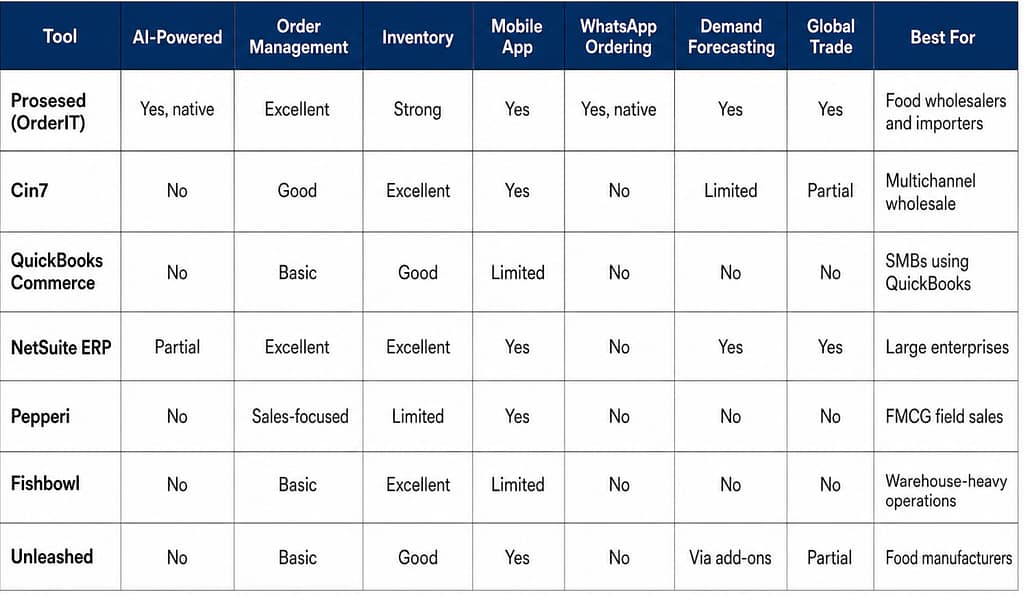
    Head-to-Head Comparison Table

    The pattern here is consistent. Prosessed is the only platform that checks the boxes food wholesalers actually need: AI-powered automation, WhatsApp ordering, demand forecasting, and global trade support, all in a single tool built for the food sector.

    If you’re ready to see how it works in practice, start a free trial at Prosessed with no card required.

    How to Choose the Right Software for Your Business Size

    Not every food wholesaler has the same needs. Here is a practical framework for narrowing down your options based on where your business is today.

    If you’re a small distributor or just getting off spreadsheets: Pick whatever fixes your worst headache first. Most tiny food shops struggle with tracking orders and sending bills. Try Prosessed’s free run – it uses smart software to handle orders, no months of setup needed. If you already use QuickBooks for money stuff, their Commerce tool works fine too.

    If you’re a mid-sized importer or distributor with a field sales team: One spot where sales teams, operations, and buyers link up matters now. Messaging through WhatsApp for orders shows up as key – so does phone-friendly layout along with predicting what sells. Built right into its bones, Prosessed fits this shape well. When stock needs stretch past meals and go channel-crazy, give Cin7 a look.

    If you’re a large enterprise with dedicated IT resources: When it comes to managing large-scale operations, NetSuite keeps up – though expect a heavy lift during rollout. If big-company features matter but cost doesn’t have to, consider Prosessed: smart systems ready fast, built like premium tools minus the long wait.

    If your main business is food manufacturing: What sets Unleashed apart is how it manages production tasks – few others match its flow. When stock control is the main hurdle, Fishbowl steps into the picture.

    Not sure which plan fits your operation? Prosessed’s team can walk you through your options.

    For more detailed guidance on selecting the right platform for your distribution setup, read our guide on how to choose the right wholesale distribution software and our roundup of the top AI ordering systems for modern food wholesalers.

    FAQs

    What is the best software for food wholesalers?

    When it comes to food wholesalers in 2026, Prosessed (OrderIT) stands out simply because it started life made just for them. Built from the ground up for food distributors, its core knows what matters. Instead of forcing round pegs into square holes, it flows naturally with how these companies actually work. While systems such as Cin7 or NetSuite can technically keep up, they weren’t shaped by daily delivery runs or perishable inventory rhythms. 

    What is food distribution software and what does it do?

    Start here if you move goods from vendor to buyer. One system handles ordering steps plus keeps count of what sits on shelves. Information travels straight from sales folks into storage areas, then lands neatly in billing sections. No retyping needed when updates happen somewhere else. Teams swap messages about stock levels using shared records instead of old spreadsheets. Predictions for future needs come from patterns already stored inside the tool. People who send supplies get tracked just like those receiving them. Smooth links between each part cut down delays that slow everything else. What gets sold shows up instantly where it matters most.

    Is there software built specifically for food importers and exporters?

    True. Among systems made for those moving food across borders, none shows intent more plainly than Prosessed. Built-in abilities – such as monitoring stock by container, setting prices in various currencies, letting buyers send orders through WhatsApp, handling variable weights during invoicing – set it apart from standard distribution software. Typical inventory or enterprise platforms lump groceries in with everyday goods, ignoring critical needs tied to spoilage risks and complex overseas logistics.

    How is AI used in wholesale distribution software?

    Orders arriving by WhatsApp or email get processed without human hands. Instead of people checking each one, software reads them and acts. Invoices appear automatically once details are confirmed. Odd requests – like strange prices or big volumes – trigger alerts. Past buying trends help guess when stock will run low. Pricing shifts depending on who the buyer is or what the market does. At the center of tools such as Prosessed, intelligence isn’t tacked on – it runs everything from within.

    What’s the difference between an ERP and a wholesale management platform?

    One system, such as NetSuite or SAP, handles everything from money matters to people tasks, shipping stuff around, making goods – pretty much all big parts of running a company. These systems pack serious power yet often come with high prices and tricky setup processes. Instead of going broad, some tools go deep – for example, Prosessed focuses only on what distributors need: moving orders smoothly, tracking stock levels, setting correct prices, keeping buyers informed. Most food-focused wholesale businesses find better results quicker using specialized software like that, spending less cash overall – even when linking up with current bookkeeping programs already in place.

    The Bottom Line

    One step ahead in 2026 stands a platform shaped by how food moves through supply chains. At the top, only a few bulky ERP systems remain – costly, hard to manage. Meanwhile, scattered across smaller operations are basic tracking apps, never made with perishable goods in mind. What sets apart the real solution is its design rooted directly in daily distribution reality.

    Starting out as a food wholesaler, importer, or distributor? Prosessed fits just there. No credit card needed for the free trial – setup wraps up in days, sometimes even less.

    If your business demands tight multichannel control, Cin7 might catch your eye. When big companies can handle the cost and tech setup, NetSuite still sets the bar. Everyone else finds themselves stuck – generic tools just don’t cut it next to software made for food distribution.

    Start your free Prosessed trial today and see the difference a food-first platform makes.

  • What is 3PL? A Food Importer’s Complete Guide to Third-Party Logistics

    Thirty percent of profits vanishes before it lands. Not magic, just broken steps piling up – rotten containers sitting too long, paperwork snarled at borders, temperature breaks during transfers, juggling four or five providers who barely talk to each other. Ever watch a load get turned away on the dock, thinking there has to be another path? This walks through that option.

    Once you reach the last line, clarity about 3PL will settle in. Food importers rely on it – here’s why. Picking the right partner involves quiet scrutiny. The details matter most when contracts appear. Questions must surface before any signature shows up on paper.

    What is 3PL? (The Simple Definition)

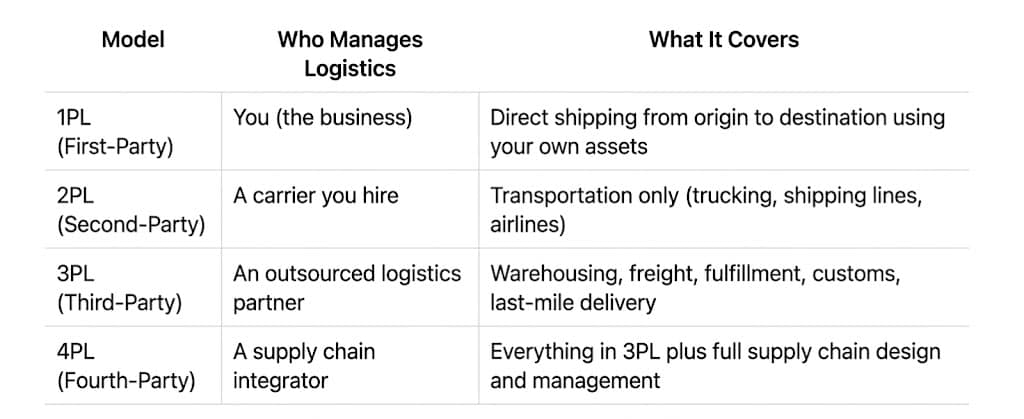
    A company might hand off parts of its shipping work to someone else. That outside help handles storage, moving goods, getting things through borders, plus sending orders out. This kind of support goes by another name – third-party logistics. Instead of doing it all themselves, businesses pass these tasks to a specialist.

    Starting at two, many food importers drift toward three. That shift packs the most punch – handling isn’t just hauling anymore. Instead of only shipping boxes, storage kicks in, oversight tightens, records keep pace, tracking sharpens. Compliance tags along through paperwork that stays on beat.

    Picture needing help moving boxes, but hiring movers rather than training your own team. That idea sits at the heart of what 3PL means. People typing that phrase seek clarity, not complicated terms filled with industry slang. Think of it like borrowing an entire shipping crew – equipment, skills, and all – from another company. Instead of constructing something yourself, you tap into ready-made support.

    Why Food Importers Specifically Need 3PL

    General logistics is complicated. Food logistics is a different level entirely. The pain points are specific, the compliance requirements are unforgiving, and the consequences of getting it wrong are costly in ways that go beyond a delayed delivery.

    Here is what makes food importing uniquely difficult:

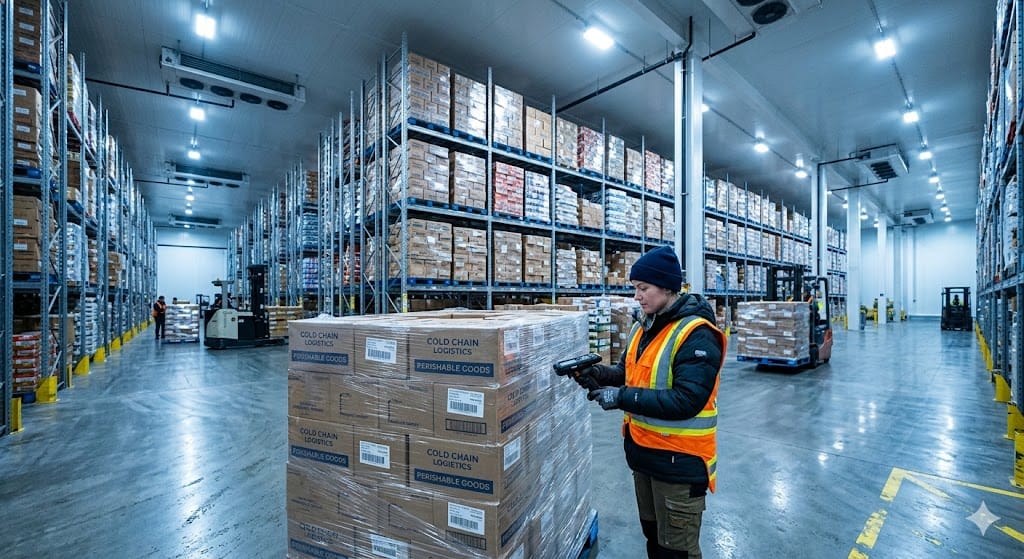
    Perishables move fast or not at all. A shipment of frozen seafood or fresh produce has a shelf life measured in days, sometimes hours. Every delay in customs, every warehouse handoff that breaks the cold chain, and every mislabeled pallet is a financial loss you cannot recover.

    FDA and FSSAI compliance is non-negotiable. If you are importing food into the United States, the FDA requires strict documentation under FSMA (Food Safety Modernization Act). For imports into India, FSSAI standards apply. A 3PL that specialises in food logistics knows these frameworks and has processes built around them, so you are not scrambling to produce records during an inspection.

    Short shelf life means demand forecasting matters. Unlike electronics or apparel, you cannot overstock food to hedge against uncertainty. You need a logistics partner who understands inventory velocity and can help you avoid both stockouts and spoilage.

    Seasonal demand spikes are brutal without the right infrastructure. Festive seasons, harvest cycles, and regulatory import windows create sudden demand surges. A capable 3PL can absorb these spikes using shared warehouse capacity and flexible carrier networks that a standalone importer simply cannot replicate.

    Consider a company importing specialty cheeses from Europe. They need temperature-controlled storage, customs brokerage familiar with dairy import regulations, last-mile delivery to specialty retailers, and returns handling for short-dated product. Managing all of that independently would require a full logistics team. A food-specialised 3PL handles it as a standard service.

    What Services Does a Food 3PL Provide?

    Some third-party logistics companies differ greatly from others. When it comes to handling food, specialised providers bring skills most standard shippers lack. What stands out? Pay attention to these details:

    Temperature-Controlled Warehousing: Start here. Storage must handle room-temperature, cool, and frozen items – no exceptions. Real-time tracking of temps matters just as much as written proof of the cold chain. When a company hesitates to demonstrate how they log temperatures, that hesitation means something. Move on without looking back.

    Customs Clearance and Documentation: Getting food through import rules means handling lots of papers on tight schedules. Some third-party logistics providers keep customs experts inside their teams, others work closely with outside pros trained in food categories like HS codes, plant health checks, advance FDA filings, and where ingredients come from.

    Order Fulfillment and Last-Mile Delivery: After arriving at the warehouse and passing through customs, products must move fast. When items reach a distribution point, someone has to handle sorting, packing, and sending them out. A specialized logistics provider for food handles these steps. Orders go straight to stores, kitchens, or people’s homes – based on how you sell. The exact path changes with each company’s setup.

    Returns and Reverse Logistics: Out of date inventory, broken items, or failed inspections – each needs a solid plan. When you work with a third-party provider, getting things back doesn’t turn into chaos behind the scenes.

    Compliance and Labelling Support: Got to change labels on lots of imported foods before they hit local shelves – details like nutrition facts, local language, rules from different countries. Warehouses that handle storage might also repackage those labels, keeps things legal without hiring someone else just for that.

    Start by numbering each point – or maybe toss in some icons – when going through provider options. That move speeds things up while cutting down on missed red flags along the way.

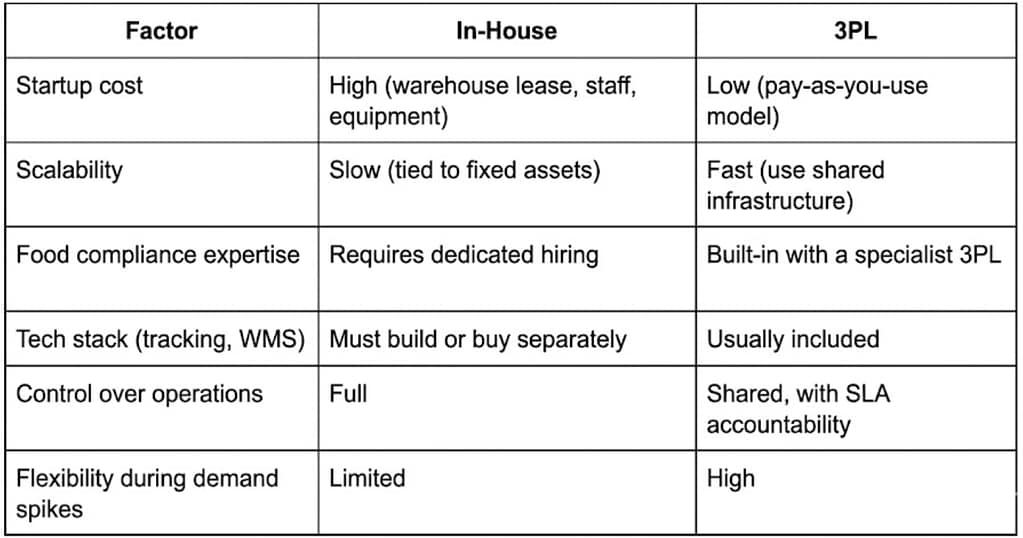
    3PL vs In-House Logistics: Which is Right for You?

    Most who bring food across borders eventually ask this. Handling shipping yourself seems safer somehow. Handing it off to a third party brings unease. Truth sits somewhere in between.

    Use this decision framework to evaluate your situation:

    When in-house makes sense:When routes stay the same and loads remain heavy, owning equipment makes sense. If spending upfront fits your budget, building custom systems pays off over time. A limited set of products often means one design works everywhere. Heavy regular movement shapes how things get built.

    When 3PL makes sense: Beyond growth, different products need varied cooling levels. Sourcing comes from various countries now. Instead of expanding clients, staff fix supply chain hiccups. Juggling suppliers eats into daily progress. Temperature needs differ across items. Work days shrink when coordination takes over. Multiple starting points mean extra complexity. Growth hides behind vendor management fatigue.

    Most growing food importers find a 3PL makes sense. Costs add up favorably, since experts handle regulations. Years of building facilities vanish when support arrives ready-made.

    Start by thinking – how many logistics providers do you handle right now? More than three might mean things are harder than they need to be. What about your cold storage records – are they ready if someone asks tomorrow? Delays happen, but when they hurt sales or upset customers, it signals something deeper. That kind of signal often means talking with a third-party provider could make sense.

    How to Choose the Right 3PL Partner as a Food Importer

    Start by thinking beyond shipping rates. That company will handle your orders every day. Instead of rushing, picture what happens when problems pop up. One delay could ripple through everything. Focus shifts once you realize their software must fit yours perfectly. Mistakes grow if systems clash. Trust builds slowly only if communication stays clear. Pick someone ready to adapt, not just react.

    1. Cold Chain Capability: Start by requesting written proof of how they manage refrigerated storage. How low does the temperature go – stay consistent across shipments? Power cuts happen; find out their response when electricity drops. Generators on site? Monitoring systems that kick in automatically if something shifts?

    2. Food-Grade Certifications: Checking if the supplier has SQF certification – this matters more than it sounds. Compliance with HACCP isn’t a bonus, it’s expected. Whatever market you’re shipping to, local food safety approvals must be in place. Skipping these? Not an option. Meeting them is simply where things begin.

    3. Tech Integrations: Starts with whether their warehouse setup talks to your business systems – maybe through links to ERP, online sales tools, or buying platforms. Seeing stock levels update live matters more than most think. Runs on sheets alone? That detail often hints at deeper gaps. Ends there.

    4. Container Planning and Procurement Support: When shipments get heavy, food moves slower. Container spots vanish fast near holidays. Lines that know your shipper pick up the phone quicker then. That gap – where others stall – is where deals tilt ahead.

    5. Scalability and Geography: When shipments get heavy, food moves slower. Container spots vanish fast near holidays. Lines that know your shipper pick up the phone quicker then. That gap – where others stall – is where deals tilt ahead.

    6. Pricing Model and Transparency: Knowing each cost tied to your shipments. Hidden charges like handling, storage, or packing often pile on top of base prices. Fuel adjustments and paperwork demands bring more expense too. Break down every provider’s pricing line by line. Match those details side-by-side with what you now pay.

    7. References from Food Clients: Requesting feedback only from those moving food across borders – general shipping stories won’t help. Since temperature control and rules vary sharply, it makes sense to listen to voices that’ve dealt with spoiled loads or customs delays. Hearing straight from importers shows what really happens when shipments hit rough spots.

    Prosessed supports food importers with procurement and container planning capabilities that connect directly to logistics workflows, which can simplify the handoff between sourcing and 3PL operations.

    Start by grabbing a 3PL assessment list ahead of your upcoming talk with vendors. That way, you avoid overlooking key points – ones that tend to surface too late, once paperwork is already sealed.

    How AI and Software are Changing 3PL for Food Importers

    The 3PL industry is not static. Technology is fundamentally reshaping what a logistics partner can offer, and food importers who understand these shifts can use them to their advantage.

    AI-Driven Demand Forecasting Instead of relying on historical averages and gut feel, modern 3PLs are using machine learning models to predict demand at the SKU level. For perishables, this means fewer stockouts and less spoilage. The system learns from your sales patterns, seasonal trends, and even external signals like weather and market pricing.

    Container Optimisation Shipping containers are expensive and space is finite. AI-powered tools can calculate optimal loading configurations, reducing the number of containers needed per shipment and cutting freight costs meaningfully.

    Automated Quoting Getting freight quotes used to take days of back-and-forth with carriers. Automated quoting tools integrated into 3PL platforms can surface rates in minutes, giving importers faster decision-making capability.

    Real-Time Tracking End-to-end visibility across your supply chain, from origin factory to warehouse shelf to last-mile delivery, is now a standard expectation. If your 3PL cannot show you where your shipment is at any moment, that is a capability gap.

    Prosessed is building in this direction, with procurement and container planning features designed specifically for food importers who need their sourcing and logistics to work together rather than operate as separate silos. The goal is not to replace your 3PL but to make the connection between what you buy and how it moves significantly smarter.

    The editorial point here is straightforward: the 3PLs that will define the next decade of food logistics are the ones investing in technology now. When you are evaluating a provider, ask what their technology roadmap looks like, not just what their current capabilities are.

    Common 3PL Mistakes Food Importers Make

    Some seasoned importers still slip up on predictable errors while picking or managing a 3PL. These missteps pop up again and again – here’s where things usually go wrong, along with better ways forward.

    Skipping checks on food-safe credential. That happens. Some third-party logistics providers carry broad shipping certificates but lack labels tied to edibles. For anything involving meals, standards like HACCP and SQF matter – no exceptions. Proof must exist. Request papers. Confirm they haven’t expired.

    Fix:  Before any agreement, get every food safety certificate they have. Look at when each one runs out. Confirm it yourself.

    Ignoring cold chain SLAs in the contract. Wrong temps in storage or shipping might ruin goods, leaving risks behind. Without clear rules on acceptable ranges, how often checks happen, or alerts for problems written into the agreement, fixes vanish once trouble hits.

    Fix: Add explicit cold chain SLAs to your 3PL agreement with defined remedies for breaches.

    Overlooking customs documentation gaps. Shipping food across borders means filling out every form exactly right. One wrong number on a customs label might mean waiting extra days – maybe even getting pulled aside for checks. Some businesses think their shipping partner takes care of everything, yet never ask where that support stops and their own duties begin.

    Fix: Map out the full documentation requirements for your import lanes and assign clear ownership for each document in your 3PL agreement.

    Poor demand forecasting handoffs. Ahead of time, knowing what’s coming helps a 3PL arrange storage room and receiving schedules. When importers hold back forecast details, chaos follows – space runs short, workers are missing, trucks stack up at loading docks.

    Fix: Establish a regular forecasting cadence with your 3PL. Share 4-week and 12-week demand projections so they can plan accordingly.

    Choosing on price alone. Most low-cost 3PL bids skip what breaks down later. Saving a tenth on warehouse charges means little when spoiled goods arrive from a broken refrigerated link. That loss swallows any earlier gain fast.

    Fix: Evaluate 3PLs on total cost of ownership, including the cost of potential failures, not just the headline rate.

    FAQ: Your 3PL Questions Answered

    How much does a 3PL cost for food importers? 

    Pricing shifts a lot depending on how much you move, what kind of goods you handle, along with required support tasks. Not every third-party logistics provider works the same way – many apply charges for receiving stock, holding it by the pallet or cubic space weekly, handling each shipment order, then shipping it out. If chilled conditions are necessary for imported food items, prices rise quite noticeably, often between one-seventh and two-fifths higher than standard room-temperature options. Someone moving modest quantities of perishable imports could see monthly expenses land anywhere from two grand up to eight thousand dollars, though bigger loads push totals upward. Full transparency matters – a detailed cost breakdown should always be shared before any agreement begins.

    What certifications should a food 3PL have?

     Start by checking for SQF – Safe Quality Food – certification, along with HACCP adherence, since that covers hazard analysis and key control points. Different countries add their own layer; take the United States, where any site holding edible goods must have FDA registration. Jump over to India, and it’s FSSAI that matters instead. Handling organics? Then dig into whether they hold proper credentials for organic storage too.

    Can a 3PL handle customs clearance?

    Most third-party logistics companies focused on food come equipped with their own licensed customs brokers or stick close to reliable outside ones. Still, what they actually do changes from one provider to another. A few take care of everything – filing FDA notices ahead of arrival, checking where goods originate, figuring out how much tax applies. Meanwhile, others step back when it comes to paperwork, leaving parts for you to sort through. The details matter. Define every task clearly before signing any contract.

    What is the difference between 3PL and cold chain logistics?

    Temperature-controlled shipping falls under logistics but targets items needing stable climate conditions. One kind of service partner handles these operations. Companies moving perishable goods often rely on third-party providers equipped for chilled transport and warehousing. These setups require special facilities plus strict handling rules during movement and storage. Some outside suppliers lack refrigerated support, so buyers must confirm this feature beforehand. Cold environments throughout the journey matter most when choosing a match.

    Can a 3PL handle customs clearance for both the US and India? 

    Across different regions, certain global 3PL providers work in more than one country, already linked with customs agents in the U.S. and India alike. A few instead narrow their focus to just one location. When bringing goods into both places, go with a third-party logistics partner confirmed active in each area – or pick individual firms per region, making sure communication rules between them are spelled out clearly.

    How do I know if my 3PL is performing well? 

    Start by watching how often deliveries arrive on schedule. That tells part of the story. Next comes whether orders match what was sent – spot-on counts matter. Temperature-sensitive loads? They must stay in range every single trip; track that number closely. Then there is paperwork speed – how fast things clear customs shapes timelines downstream. Damage at delivery breaks trust, so keep an eye on that total too. When it works well, your provider shares all this without waiting for you to ask, either online or in updates they send out.

    Conclusion: Making Your Food Import Operation Work Smarter

    Start late, finish early – that’s how tight food shipping windows feel. Juggling rules from country to country eats up hours before breakfast. When weather shifts buying patterns, plans crack like dried soil. Every truck delay chips away at profit, slowly. Smooth moves on the ground? That shapes what customers actually pay. Winning isn’t just in the product; it lives inside every warehouse decision.

    A strong third-party logistics provider takes heavy tasks off your shoulders, swapping them for solid systems, real skill, and clear responsibility. What matters most? Picking someone fluent in food – not just a carrier that bolted on refrigerated space to an ordinary warehouse.

    Start by looking past the warehouse walls. Your sourcing choices ripple through every part of delivery flow. One wrong move in container setup can quietly lift total expenses. What you predict today molds how much space you’ll need tomorrow. Teamwork between buying and moving goods wipes out wasted effort. Efficiency grows when these pieces stop working alone.

    See how Prosessed helps food importers streamline procurement and container planning so your supply chain works as one connected system rather than a series of handoffs.

  • How to Choose the Right Wholesale Distribution Software (And Why Most Businesses Get It Wrong)

    Most wholesalers pick the wrong software. Not because the software is bad. But because they chose it the wrong way.

    This guide cuts through the noise. No generic lists. No vendor hype. Just the real criteria, the real costs, and a clear framework to get it right.


    The Painful Truth About Software Selection

    Picking software is like buying shoes. It’s not about the fanciest pair. It’s about finding the one that actually fits you.

    Most businesses skip that part. Then they wonder why everything hurts.


    1. The 7 Mistakes That Sink Software Projects

    These aren’t rare. They happen to smart teams constantly.

    Mistake 1: Chasing the Famous Brand Big-name software wins on marketing, not on fit. The most popular system in the market might be completely wrong for your business.

    Mistake 2: Obsessing Over the Cheapest Price Cheap upfront often means expensive later. Hidden costs ,customization, training, workarounds ,add up fast and quietly.

    Mistake 3: Not Knowing What You Actually Need Most teams think they know their requirements. They don’t. Generic checklists miss the real problems hiding in daily workflows.

    Mistake 4: Planning Implementation After Signing You don’t start planning after you sign the contract. You start before. Teams that skip this step hit nasty surprises post-launch.

    Mistake 5: Stakeholder Chaos When finance, operations, and IT all want different things, nothing moves. You need everyone aligned before you pick anything.

    Mistake 6: Moving Messy Data Into a New System Years of bad spreadsheet data don’t get better in a new system. They get worse. Clean the data first, migrate second.

    Mistake 7: Skipping Change Management Even perfect software fails if your team doesn’t use it. Training and buy-in aren’t optional ,they’re the whole game.

    The real reason ERP projects fail is almost never a bad product. It’s bad planning ,vague goals, skipped integrations, and training that comes too late.


    2. How to Actually Evaluate Software

    The right software depends on where your business is right now. Not where you want to be in five years.

    Small businesses need cost and simplicity. Systems like Odoo or Business Central cover the basics. The main risk? You’ll outgrow them faster than you think.

    Mid-market companies need scalability and integration. NetSuite and Acumatica handle that well. The risk here is managing too many systems talking to each other.

    Enterprise distributors need control and deep customization. SAP and Oracle serve this tier. The risk is over-engineering processes that don’t need it.

    Cloud vs. On-Premises ,the honest trade-off:

    Cloud software sets up fast, scales easily, and the vendor handles maintenance. But your data lives on their servers and customization is limited.

    On-premises software gives you full control and deep customization. But it costs more upfront and needs your own IT team to manage it.

    Neither is better. One is better for you. Know the difference before you decide.

    Don’t just look at the license fee. Build a 5-year cost model ,including training, integrations, upgrades, and downtime. That’s the real number.


    3. The Systems That Keep Your Warehouse Running

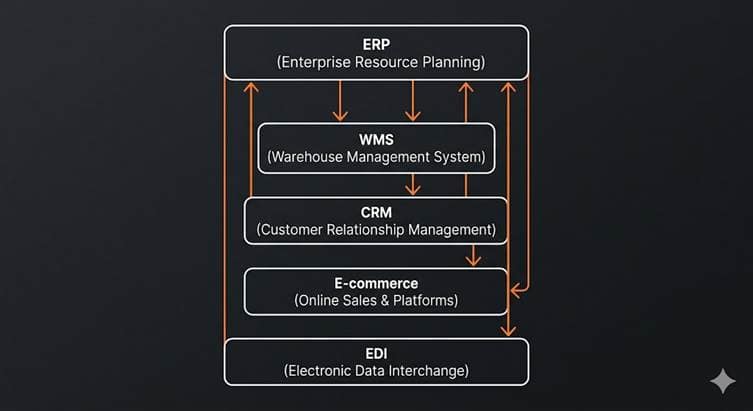
    Modern wholesale distribution isn’t one system. It’s a team of systems that must talk to each other ,perfectly.

    ERP is your backbone. It handles finance, inventory, pricing, and procurement. Every other system should feed data back into it.

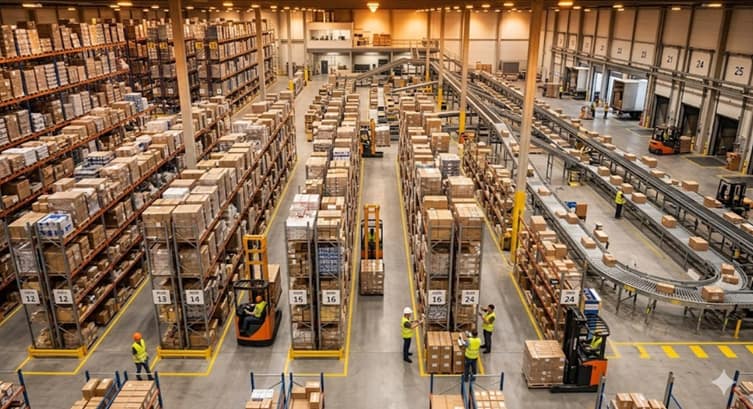
    WMS (Warehouse Management System) runs your daily warehouse ,picking, packing, shipping. It must stay in sync with your ERP in real time. If it doesn’t, your stock data lies to you.

    CRM holds your customer and sales data. Without a live connection to your ERP, your sales team is quoting stock that doesn’t exist.

    E-commerce platforms capture online orders. Without integration, someone has to enter those orders manually. That’s a disaster waiting to happen.

    EDI and APIs are how your systems actually talk to each other. These connections are fragile. A small update in one system can silently break your entire order flow.

    The number one failure point in distribution IT is integration. When your WMS and ERP don’t share live data, stockouts and overselling follow.


    4. The Real Cost of Getting It Wrong

    This isn’t just embarrassing. It’s financially devastating.

    Recovering from a failed ERP implementation typically costs 150–200% of the original project budget. If your project was $500K, recovery can easily hit $750K to $1M ,or more.

    Waste Management sued SAP for $100M over a botched ERP rollout. MillerCoors sued HCL for $100M when a new system failed entirely.

    Beyond the lawsuits, there’s something harder to measure: time. Every month spent untangling a bad system is a month your competitors are moving forward. Your digital roadmap freezes. New initiatives stall. Customers notice.

    The smallest distributor might survive a wrong choice invisibly. For larger companies, an ERP failure can wreck balance sheets ,and careers.


    5. Which Software Is Right for You?

    There’s no universally best system. There’s only the best system for your situation.

    NetSuite is built for fast-growing mid-market distributors. It handles high order volumes, multiple warehouses, and consolidated financials across subsidiaries. It’s powerful but complex ,not a fit for early-stage teams.

    SAP Business One suits smaller distributors who need solid supply chain basics ,lot tracking, batch management, and standard warehouse automation. It’s reliable and proven, though its cloud evolution has been slower than pure-cloud competitors.

    Odoo is open-source and modular. Start with only what you need and expand over time. It’s extremely affordable and highly customizable. The trade-off: advanced features often require developers to configure.

    Cin7 is not a full ERP ,it’s an inventory and order management platform. It shines for businesses adding sales channels or warehouse locations. It connects inventory, 3PL, e-commerce, and POS in one place. It deploys in weeks, not months.

    Fishbowl sits on top of QuickBooks and adds real warehouse management ,barcoding, kitting, multi-warehouse tracking. It’s the right call when you’re on QuickBooks, need more warehouse depth, and don’t want a six-figure ERP bill. It will be outgrown by fast-scaling businesses.

    The question isn’t “which is best?” The question is: which one fits where my business is today ,and won’t become a bottleneck tomorrow?

    Not sure which one fits your business? That’s exactly what Prosessed is built for. Prosessed uses AI to analyse your operations, your stage, and your goals ,then tells you which system actually makes sense for you. No sales pitch. No guesswork. Just a clear answer backed by data.

    The question isn’t “which is best?” The question is: which one fits where my business is today ,and won’t become a bottleneck tomorrow? Prosessed helps you answer that.

    OrderIt App by Prosessed AI

    The OrderIt app by Prosessed AI is a smart order management solution designed to simplify and streamline the entire sales and distribution process. It empowers wholesalers, distributors, and manufacturers with real-time visibility, efficient order tracking, and seamless inventory integration. With an intuitive interface and automation-driven workflows, OrderIt helps businesses reduce manual effort, improve accuracy, and boost overall productivity, making it easier to scale operations and deliver better customer experiences.


    6. How AI Is Changing the Way Distributors Decide

    The future of software selection isn’t a one-time choice. It’s a continuous, data-driven process. AI is at the center of it.

    Smart companies are now modeling decisions before committing. Instead of guessing which system is right, they simulate the outcome first.

    The next generation of ERP isn’t just recording transactions. It’s recommending actions ,telling you to move stock between warehouses before a shortfall hits, or flagging that your order volume has doubled and your current system is showing strain.

    This isn’t science fiction. It’s already starting. Wholesalers who adopt decision intelligence early will make faster, better calls than competitors still relying on gut feel and static reports.

    AI doesn’t replace human judgment in software selection. It makes that judgment sharper ,with simulated ROI, risk models, and continuous feedback instead of a one-time gut call.


    7. A Simple 8-Step Framework to Get It Right

    Stop guessing. Use this every time.

    Step 1 ,Define what success actually looks like. Set measurable goals before you look at a single demo. “20% faster fulfillment” beats “better software” as a target every time.

    Step 2 ,Map your real workflow. Walk through your quote-to-cash and purchase-to-pay processes step by step. Find where the actual bottlenecks and errors live.

    Step 3 ,Separate must-haves from nice-to-haves. Involve warehouse leads, finance, and IT. Ask vendors to demonstrate your exact scenarios ,not their best-case demos.

    Step 4 ,Score vendors on a weighted scorecard. Pick 3–5 vendors max. Score on fit, integration ease, total cost, and vendor stability. Keep the list short to avoid decision fatigue.

    Step 5 ,Run a pilot on your key processes. Test a real scenario in a sandbox before going live. It’s far cheaper to find problems here than after full rollout.

    Step 6 ,Lock down integration plans before you sign. Confirm who owns each connection ,ERP to WMS, ERP to CRM. Negotiate implementation support in the contract, not as an afterthought.

    Step 7 ,Build a 5-year cost model. Include license fees, hosting, consulting, training, upgrades, and a 20–30% buffer for overruns. Compare to expected savings and revenue growth.

    Step 8 ,Decide, launch, and keep measuring. Make a clear decision with leadership sign-off. Measure early results against your goals. Adjust as you learn.


    The Bottom Line

    The best software for your business is the one that fits where you are today ,and grows with you without becoming a problem tomorrow.

    It’s not the most famous brand. It’s not the cheapest option. And it’s definitely not whatever your competitor is using.

    Choose strategy, not just software. Plan implementation before you sign. Keep every decision tied to a real business outcome.

    That’s how the best distributors make this call. And with AI-powered decision intelligence, that process is getting sharper, faster, and more reliable every year.


  • Stuck in Manual Procurement? AI Solutions for Food Wholesalers

    Stuck in Manual Procurement? AI Solutions for Food Wholesalers

    In the fast-paced world of food wholesale, where freshness, efficiency, and thin margins reign supreme, clinging to outdated manual procurement processes is like trying to win a marathon with lead weights. Are you constantly battling stockouts of high-demand items, negotiating prices on the fly, or drowning in a sea of spreadsheets and phone calls just to get your orders placed? The stress of inaccurate forecasting, unexpected price hikes, and mountains of paperwork can feel overwhelming, impacting not only your bottom line but also your team’s morale and your ability to serve customers consistently. It’s a cycle of reactive decision-making that leaves little room for strategic growth or innovation. This persistent struggle with manual procurement challenges can hold back even the most dedicated food wholesalers, preventing them from achieving the agility and profitability needed in today’s competitive market.

    The Problem: The Daily Grind of Manual Procurement Challenges in Food Wholesale

    Imagine your typical day: you start with an inventory check, only to find critical items are running low. A quick scan of last week’s sales tells you one thing, but a sudden surge in demand for a seasonal product tells another. You pick up the phone, calling multiple suppliers to compare prices and availability, often waiting on hold or playing phone tag. Then comes the data entry, manually logging purchase orders, updating stock levels, and trying to reconcile invoices against deliveries that might not perfectly match. Each step is a bottleneck, prone to human error, and eating valuable time that could be spent on customer relationships or market expansion.

    This reactive approach makes long-term planning almost impossible. You might over-order to compensate for unreliable lead times, tying up capital in slow-moving stock, or under-order and miss out on sales. Price fluctuations, especially for perishable goods, can erode your margins before you even realize it. The reliance on individual buyer knowledge means critical information is siloed, and if a key team member is absent, the entire process grinds to a halt. For food wholesalers, where product freshness and rapid turnover are paramount, these manual procurement challenges aren’t just inefficient – they are a direct threat to profitability and customer satisfaction.

    Why This Keeps Happening: Understanding the Root Causes

    It’s not for lack of trying or dedication that manual procurement challenges persist in food wholesale. Several systemic factors contribute to this ongoing struggle:

    1. Legacy Systems and Resistance to Change: Many wholesalers operate on established, often outdated systems that are difficult to integrate or replace. The sheer effort and perceived risk of transitioning to new technology can be daunting, leading to a “better the devil you know” mentality.
    2. Complex Supply Chains: Food wholesale involves a highly intricate web of suppliers, varying product lifecycles, and diverse delivery schedules. Managing this complexity manually is inherently challenging, making it hard to track everything in real-time.
    3. Lack of Centralized Data: Critical information like historical sales, supplier performance, pricing agreements, and inventory levels often resides in disparate spreadsheets, individual inboxes, or even on paper. This fragmented data prevents holistic decision-making.
    4. Time Constraints and “Firefighting”: Procurement teams are constantly reacting to immediate needs – urgent orders, unexpected shortages, or sudden price changes. This constant firefighting leaves little time to strategize, optimize processes, or explore new solutions.
    5. Perishable Nature of Products: The limited shelf life of food products adds immense pressure. Errors in forecasting or delays in ordering can lead to significant waste and financial losses, making manual processes particularly risky.

    The Short Answer: AI-Powered Procurement Automation

    The solution to these deeply ingrained manual procurement challenges for food wholesalers lies in adopting advanced Artificial Intelligence (AI) and machine learning (ML) powered procurement platforms. These intelligent systems automate the repetitive, time-consuming tasks that currently bog down your team, offering proactive insights rather than reactive responses. By leveraging historical data, real-time market trends, and even external factors like weather, AI can predict demand with far greater accuracy, optimize purchasing decisions, and streamline the entire order-to-delivery cycle. It transforms procurement from a reactive, labor-intensive cost center into a strategic, data-driven value driver for your business.

    What The Solution Looks Like In Real Life: Practical AI Implementation

    Imagine a world where your procurement team spends less time on tedious data entry and more time on strategic supplier negotiations and relationship building. With an AI-powered system, this becomes reality. Here’s a glimpse:

    • Automated Demand Forecasting: The AI analyzes years of sales data, seasonality, promotions, and even external factors (like holidays or local events) to predict future demand for each SKU with remarkable precision. No more guessing or relying on gut feelings.
    • Optimized Order Generation: Based on the forecast, current inventory levels, minimum order quantities, and supplier lead times, the system automatically suggests optimal purchase orders. It can even consider price breaks and preferred suppliers.
    • Dynamic Price Negotiation & Comparison: AI continuously monitors supplier catalogs and market prices, flagging discrepancies or opportunities for better deals. Some advanced systems can even automate low-level price inquiries and comparisons across multiple vendors.
    • Real-time Inventory Management: Integrations with your warehouse management system provide a live view of stock levels, reducing the risk of stockouts or overstocking. The system can alert you to potential issues before they become critical.
    • Supplier Performance Tracking: The AI maintains a digital record of supplier reliability, delivery times, and quality, helping you make informed decisions about who to partner with.
    • Streamlined Invoice Reconciliation: Automating the matching of purchase orders, goods received, and invoices significantly reduces manual errors and accelerates payment processes.

    This isn’t about replacing human expertise, but augmenting it, allowing your team to focus on high-value activities that truly require their strategic input. It’s about leveraging technology to overcome the inherent complexities of supply chain management in food wholesale.

    Step By Step: From Manual Chaos to AI-Driven Efficiency

    Transitioning to AI-powered procurement might seem like a monumental task, but it can be approached systematically:

    1. Assess Your Current State: Document your existing manual procurement challenges, pain points, and current software (if any). Identify key metrics like order accuracy, lead times, and inventory holding costs.
    2. Define Your Goals: Clearly articulate what you want to achieve with AI – e.g., reduce stockouts by X%, cut procurement time by Y%, improve forecast accuracy by Z%.
    3. Research & Select a Solution: Explore AI-powered procurement platforms specifically designed for the food wholesale industry. Look for features like demand forecasting, vendor management, and integration capabilities. Consider solutions like Prosessed AI’s product offerings that are tailored for your needs.
    4. Data Preparation & Integration: This is a critical step. Centralize your historical sales data, inventory records, and supplier information. Work with your chosen provider to integrate the AI platform with your existing ERP or accounting software.
    5. Pilot Program & Training: Start with a pilot program on a manageable segment of your product catalog or with a specific set of suppliers. Train your procurement team thoroughly, emphasizing how AI will enhance their roles.
    6. Phased Rollout: Gradually expand the AI solution across more products and suppliers. Continuously monitor performance, gather feedback, and make adjustments as needed.
    7. Continuous Optimization: AI systems learn over time. Regularly review performance metrics, refine parameters, and leverage new features as they become available to maximize efficiency and ROI.

    How This Looks For Different People in Your Organization

    The impact of overcoming manual procurement challenges resonates across your entire organization:

    • For the Procurement Manager: Instead of juggling dozens of spreadsheets and phone calls, you’re now reviewing AI-generated purchase suggestions, fine-tuning them based on strategic insights, and focusing on building stronger supplier relationships. You have real-time visibility into inventory and can proactively address potential issues, transforming your role from reactive “firefighter” to strategic “orchestrator.”
    • For the Sales Team: With fewer stockouts and more accurate inventory, the sales team can confidently promise availability to customers, improving order fulfillment rates and customer satisfaction. They can also provide feedback on new product demands or market trends directly into a system that learns and adapts.
    • For the Warehouse Manager: Predictable deliveries and optimized order quantities mean a more organized warehouse. Less rush and fewer unexpected shipments reduce labor costs and improve operational flow. Reduced spoilage from overstocking translates directly to cost savings.
    • For the Business Owner/CEO: You gain unparalleled visibility into procurement costs, margins, and supply chain health. Data-driven insights enable better financial planning and strategic decision-making. The business becomes more agile, competitive, and resilient to market fluctuations, ultimately boosting profitability and growth potential.

    What Might Still Be Holding You Back

    Even with clear benefits, some common concerns can delay the adoption of AI in procurement:

    • Cost of Implementation: The initial investment in software and integration can seem significant. However, it’s crucial to view this as an investment with a clear ROI through reduced waste, improved efficiency, and better margins.
    • Fear of Complexity: The term “AI” can sound intimidating. However, modern platforms are designed with user-friendly interfaces, abstracting away the underlying technical complexity.
    • Data Quality Concerns: “Garbage in, garbage out” is a valid concern. Addressing this involves a focused effort on data clean-up and establishing robust data entry protocols, which ultimately benefits the business regardless of AI adoption.
    • Resistance from Team Members: Employees might fear job displacement or the need to learn new skills. Effective change management, emphasizing how AI empowers rather than replaces, and providing thorough training are essential.
    • Lack of Internal Expertise: Many wholesalers may not have in-house AI specialists. Partnering with a reputable vendor that offers comprehensive support and implementation services mitigates this challenge.

    Common Mistakes to Avoid When Adopting AI Procurement

    • Underestimating Data Preparation: Skipping or rushing data cleansing will lead to inaccurate forecasts and unreliable system recommendations. Invest time in ensuring your historical data is clean and complete.
    • Ignoring Change Management: Introducing new technology without proper communication, training, and addressing employee concerns can lead to resistance and failed adoption.
    • Expecting Instant Perfection: AI systems, especially those based on machine learning, need time to learn and optimize. Be prepared for a gradual improvement curve and continuous refinement.
    • Over-automating Too Soon: Don’t try to automate everything at once. Start with a pilot project, prove its value, and then gradually expand automation.
    • Choosing a “One-Size-Fits-All” Solution: Food wholesale has unique needs. Select a platform that understands the specific challenges of perishable goods, variable lead times, and complex supplier networks.
    • Neglecting Supplier Collaboration: AI tools enhance, not replace, supplier relationships. Ensure your system supports seamless communication and data exchange with your key vendors.

    Your Implementation Checklist for AI-Powered Procurement

    Use this checklist to guide your journey away from manual procurement challenges:

    1. ✓ Clearly define the specific manual procurement challenges you aim to solve.
    2. ✓ Inventory and clean your historical sales, inventory, and supplier data.
    3. ✓ Research and identify AI procurement solutions tailored for food wholesale.
    4. ✓ Secure executive buy-in and allocate sufficient budget for the project.
    5. ✓ Form a cross-functional implementation team (procurement, IT, operations).
    6. ✓ Develop a clear communication plan for your team about the upcoming changes.
    7. ✓ Establish key performance indicators (KPIs) to measure success.
    8. ✓ Plan for thorough user training and ongoing support.
    9. ✓ Schedule regular reviews to assess performance and identify areas for optimization.
    10. ✓ Foster a culture of continuous improvement and adaptation within your procurement team.

    Your 7-Day Plan to Kickstart AI Procurement Exploration

    This phased approach helps you begin tackling manual procurement challenges this week:

    • Day 1: Internal Brainstorm & Pain Points: Gather your procurement team for an hour. List every single pain point, inefficiency, and manual task related to procurement. Prioritize the top 3-5 most frustrating and time-consuming issues.
    • Day 2: Data Availability Check: Identify where your key procurement data (historical sales, inventory levels, supplier price lists, lead times) currently resides. Is it in spreadsheets, ERP, or scattered? Start thinking about how it could be centralized.
    • Day 3: Research & Learn: Dedicate an hour to researching “AI procurement for food wholesale.” Watch introductory videos, read articles, and start to familiarize yourself with the core concepts and available solutions.
    • Day 4: Supplier Input & Aspirations: Reach out to one or two key suppliers. Ask them about their experiences with automated ordering systems or data sharing. What would make procurement easier for them?
    • Day 5: Cost of Inaction Calculation: Try to estimate the financial impact of your top 1-2 manual procurement challenges. How much do stockouts, overstocking, or manual errors cost your business monthly? This helps build a business case.
    • Day 6: Demo Request & Next Steps: Identify 1-2 promising AI procurement vendors. Visit their websites (like Prosessed.ai) and request a demo or a consultation to see their solutions in action.
    • Day 7: Internal Report & Action Plan: Compile your findings from the week. Outline the biggest opportunities for improvement and present a preliminary recommendation to your leadership on exploring AI procurement solutions further. Consider signing up for an initial consultation or a free trial.

    Transform Your Procurement, Transform Your Business

    Moving beyond the daily struggle of manual procurement challenges in food wholesale is not just about adopting new technology; it’s about embracing a smarter, more strategic way of doing business. By leveraging the power of AI, you can unlock unprecedented efficiencies, reduce costs, minimize waste, and ensure your shelves are always stocked with what your customers need. It’s an investment in your company’s future, enabling agility, growth, and sustained profitability in an ever-evolving market. Don’t let outdated processes hold you back any longer. Start your journey towards intelligent procurement today.

    Ready to revolutionize your food wholesale operations? ✨ Get Started Free with Prosessed AI and see how intelligent automation can transform your procurement processes.

    Sources

    FAQs About AI Solutions for Food Wholesalers

    Q: Will AI procurement replace my current team members?

    A: AI-powered procurement platforms are designed to automate repetitive, data-intensive tasks, not to replace human expertise. Instead, they free up your team to focus on higher-value activities like strategic supplier negotiations, relationship building, and market analysis, enhancing their roles and overall departmental efficiency.

    Q: How long does it take to implement an AI procurement system?

    A: The implementation timeline can vary depending on the complexity of your existing systems, the volume of data, and the scope of the rollout. A pilot program might take a few weeks to a couple of months, with a full-scale rollout potentially spanning several months. Key factors include data preparation and integration with your current ERP or accounting software.

    Q: Is AI procurement suitable for small to medium-sized food wholesalers?

    A: Absolutely. While often associated with large enterprises, many AI procurement solutions are now scalable and accessible for small to medium-sized businesses. The benefits of reduced waste, improved efficiency, and better forecasting are crucial for operations of all sizes, helping even smaller wholesalers compete effectively.

    Q: What kind of data is needed for AI procurement to work effectively?

    A: AI systems thrive on data. Key data inputs include historical sales records, current inventory levels, supplier catalogs, pricing agreements, lead times, and even external market data. The more comprehensive and accurate your data, the better the AI can learn and provide precise recommendations.

    Q: How does AI handle the volatile nature of food prices and seasonality?

    A: This is where AI excels. Machine learning algorithms are designed to identify patterns and anomalies in large datasets. They can analyze historical price fluctuations, seasonal demand shifts, and even external factors (like weather patterns affecting harvests) to make more accurate predictions and procurement recommendations than manual methods, helping to mitigate risk.

  • Solving Food Wholesale Procurement Pains with AI Automation

    Solving Food Wholesale Procurement Pains with AI Automation

    Imagine a bustling food wholesale operation, where orders fly in, inventory constantly shifts, and the clock ticks relentlessly on perishable goods. For many, this isn’t just a picture; it’s a daily battle against inefficiencies, unexpected shortages, and the hidden costs of overstocking. Manual procurement processes, reliant on spreadsheets and phone calls, struggle to keep pace with volatile market demands, leading to wasted time, lost revenue, and unnecessary stress. The food industry, in particular, faces unique challenges with fluctuating prices, seasonal availability, and stringent quality controls. It’s a complex environment where traditional methods often fall short, leaving businesses vulnerable to profit erosion and operational bottlenecks.

    What if you could transform this chaos into a streamlined, predictive system? What if your procurement team could anticipate demand with uncanny accuracy, optimize supplier relationships, and virtually eliminate waste? The answer lies in harnessing the power of artificial intelligence. Prosessed is here to guide you through how AI automates food wholesale procurement, turning your biggest pain points into powerful competitive advantages.

    The Problem: Navigating the Minefield of Manual Food Procurement

    The day-to-day reality of food wholesale procurement without automation is a constant juggling act. Procurement managers are often bogged down by repetitive tasks, spending countless hours on manual data entry, cross-referencing spreadsheets, and chasing down suppliers for pricing and availability updates. This labor-intensive approach leaves little room for strategic decision-making or proactive problem-solving. Stockouts of critical ingredients can halt production or disappoint customers, while overstocking leads to costly spoilage, especially with fresh produce and dairy products.

    Price volatility in the food market adds another layer of complexity. Negotiating with multiple suppliers, monitoring market trends, and ensuring consistent quality across diverse product lines consumes significant resources. Furthermore, the risk of human error is ever-present, leading to incorrect orders, missed delivery windows, or compliance issues. These inefficiencies don’t just impact the bottom line; they erode trust with both suppliers and customers, making growth an uphill battle.

    Why This Keeps Happening: The Root Causes of Procurement Headaches

    The challenges in food wholesale procurement aren’t simply a matter of effort; they stem from systemic issues within traditional operations:

    • Lack of Real-time Data Integration: Information silos prevent a holistic view of inventory, sales, supplier performance, and market conditions. Data is often outdated by the time it’s compiled, making timely decisions impossible.
    • Reliance on Tribal Knowledge: Critical insights about supplier reliability, seasonal pricing, or quality specifics often reside in the heads of experienced employees, making processes vulnerable to staff turnover and difficult to scale.
    • Limited Tools for Forecasting Complex Variables: Traditional forecasting methods struggle with the myriad variables affecting food demand and supply, such as weather patterns, public holidays, local events, and sudden shifts in consumer preferences.
    • Fragmented Supplier Networks: Managing relationships with dozens or even hundreds of suppliers, each with their own ordering systems, pricing structures, and delivery schedules, creates immense administrative overhead.
    • Resistance to Change: Implementing new technologies can seem daunting. The perceived cost, complexity, and fear of disrupting established routines often deter businesses from exploring transformative solutions.

    The Short Answer: AI Transforms Procurement from Reactive to Predictive

    AI automates food wholesale procurement by integrating and analyzing vast datasets to provide predictive insights, optimize ordering processes, and streamline supplier interactions. It shifts procurement from a reactive, manual task to a proactive, strategic function. By leveraging machine learning, AI can forecast demand with high accuracy, identify optimal suppliers, negotiate better terms, and manage inventory levels in real time, significantly reducing waste and maximizing profitability. This allows your team to focus on higher-value activities, ensuring a more resilient and efficient supply chain.

    What The Solution Looks Like In Real Life: A Glimpse into AI-Powered Procurement

    Imagine your procurement team starting their day not with a pile of manual requisitions, but with a predictive dashboard. This dashboard, powered by artificial intelligence, would instantly show optimized order recommendations for the next week, factoring in current inventory, sales forecasts, supplier lead times, and even upcoming weather events or holidays. You would see alerts for potential supply chain disruptions, allowing you to source alternatives before a problem arises.

    In this AI-driven reality, Prosessed AI tools can automatically generate purchase orders, send them to pre-qualified suppliers, and track their delivery status, all without human intervention. The system continuously learns from every transaction, refining its predictions and optimizing sourcing strategies. For instance, if a particular brand of organic produce consistently sells out faster than anticipated, the AI adjusts future orders accordingly. If a supplier frequently delays deliveries, the system can flag them for review or suggest alternative, more reliable options. This proactive, data-informed approach ensures you always have the right products, in the right quantities, at the best possible price, minimizing waste and enhancing customer satisfaction.

    Step By Step: How AI Transforms Your Procurement Process

    Implementing AI to automate food wholesale procurement is a journey, but a highly rewarding one. Here’s a typical progression:

    1. Data Integration and Cleansing: The first step involves consolidating all your disparate data sources-sales records, inventory levels, supplier catalogs, market prices, and historical purchase orders-into a unified platform. Crucially, this data is then “cleansed” to remove inconsistencies and errors, establishing a reliable foundation for AI analysis.
    2. AI Model Training and Calibration: Once data is clean, AI algorithms are trained using this historical information to recognize patterns, predict demand, and identify optimal ordering parameters. This phase often involves a period of calibration, where the system’s recommendations are fine-tuned by your procurement experts.
    3. Automated Demand Forecasting: The AI system begins to predict future demand with increasing accuracy. It considers seasonal trends, promotional activities, external factors like local events or economic indicators, and even real-time sales data to generate precise forecasts for each product.
    4. Supplier Discovery and Negotiation Support: AI can analyze supplier performance metrics-such as delivery reliability, quality ratings, and pricing history-to recommend the best vendors for specific needs. It can also provide data-driven insights to strengthen your negotiation position, helping secure better terms and prices.
    5. Intelligent Order Generation and Management: Based on demand forecasts and optimized supplier choices, the AI automatically generates purchase orders. It manages order fulfillment from creation to delivery, tracking shipments and updating inventory levels in real-time, reducing manual oversight.
    6. Performance Monitoring and Continuous Optimization: The system continuously monitors key performance indicators (KPIs) like stockout rates, spoilage, cost savings, and supplier performance. It learns from new data, adapts to changing market conditions, and suggests further optimizations, ensuring an always-improving procurement cycle.

    How This Looks For Different People In Your Organization

    AI-powered procurement doesn’t just change a process; it transforms roles and empowers your team across the organization:

    Procurement Manager: From Tactical to Strategic

    For the Procurement Manager, AI frees up valuable time spent on repetitive data entry and chasing orders. Instead, they can focus on strategic initiatives: cultivating stronger supplier relationships, exploring innovative sourcing opportunities, negotiating complex contracts, and contributing to long-term business growth. They become a strategic partner, leveraging AI-generated insights to make informed decisions that impact the entire supply chain. They can review performance dashboards, quickly identify areas for improvement, and ensure compliance.

    Warehouse Manager: Optimized Inventory, Reduced Waste

    The Warehouse Manager benefits from highly accurate demand forecasts and optimized inventory levels. They experience fewer stockouts, leading to smoother operations and reduced rush orders. Critically, AI helps minimize overstocking of perishable goods, drastically cutting down on spoilage and associated financial losses. With predictable inflows and outflows, space utilization improves, and labor can be allocated more efficiently, directly impacting the bottom line.

    Finance Department: Enhanced Cost Control and Budgeting

    For the Finance Department, AI brings unprecedented transparency and control over procurement spending. Predictive pricing models and optimized supplier selection lead to significant cost savings. Accurate forecasting improves budgeting, reducing unexpected expenditures and allowing for more precise financial planning. The reduction in waste and spoilage directly translates into higher profit margins and a healthier financial outlook. The detailed data provided by AI also simplifies auditing and compliance reporting.

    What Might Still Be Holding You Back: Addressing Common Concerns

    Despite the clear advantages, some common concerns might give businesses pause before adopting AI for procurement:

    • Cost of Implementation: The initial investment in AI technology and integration can seem significant. However, it’s crucial to view this as an investment with a high ROI, considering the long-term savings from reduced waste, optimized pricing, and increased efficiency. Solutions like those offered by Prosessed are designed to provide scalable entry points.
    • Data Quality Concerns: Many businesses worry their existing data isn’t clean or comprehensive enough for AI. While data quality is vital, modern AI platforms include robust data cleansing and integration tools. Starting with a pilot project can help identify and address data gaps progressively.
    • Fear of Job Displacement: The misconception that AI will replace human jobs is common. In reality, AI augments human capabilities, automating mundane tasks and allowing employees to focus on strategic, creative, and higher-value activities. It elevates roles rather than eliminating them.
    • Complexity of Integration: Integrating new AI systems with existing ERP, inventory, and supplier management platforms can seem daunting. However, leading AI providers offer seamless integration capabilities, often through APIs and pre-built connectors, minimizing disruption.

    Common Mistakes To Avoid When Implementing AI Procurement

    To ensure a smooth and successful transition to AI-driven procurement, steer clear of these pitfalls:

    • Ignoring Data Hygiene: AI is only as good as the data it’s fed. Neglecting data cleansing and ongoing data quality management will lead to inaccurate predictions and unreliable recommendations.
    • Expecting Immediate Perfection: AI models require training and refinement. Don’t expect instant, flawless results. Allow for a learning period and be prepared for continuous optimization based on real-world performance.
    • Underestimating Change Management: Introducing AI is a significant organizational change. Failing to communicate the benefits, train staff adequately, and address concerns can lead to resistance and slow adoption.
    • Not Involving End-Users: Your procurement team’s insights are invaluable. Involve them in the planning, implementation, and feedback stages to ensure the solution meets their needs and gains their buy-in.
    • Overlooking Supplier Integration: For maximum efficiency, consider how your AI system will interact with your key suppliers. Smooth data exchange and communication channels are crucial for automated ordering and tracking.
    • Failing to Define Clear KPIs: Without clear metrics for success (e.g., reduction in waste, improved delivery times, cost savings), it’s difficult to measure the ROI and demonstrate the value of the AI system.

    Your Implementation Checklist: Paving the Way for Smart Procurement

    Ready to automate food wholesale procurement? Use this checklist to guide your journey:

    • Define Clear Objectives: What specific procurement pains do you want to solve (e.g., reduce spoilage by X%, improve on-time delivery by Y%)?
    • Assess Current Systems: Understand your existing ERP, inventory management, and supplier communication tools. Identify integration points.
    • Secure Leadership Buy-In: Ensure executive sponsorship and cross-departmental support for the AI initiative.
    • Cleanse and Prepare Data: Invest time in standardizing and cleaning historical sales, inventory, and supplier data.
    • Select the Right Partner: Choose an AI provider with expertise in food wholesale and a proven track record, like Prosessed AI tools.
    • Pilot with a Small Segment: Start with a manageable product category or supplier group to test the system and gather feedback before a full rollout.
    • Train Your Team: Provide comprehensive training for all users, focusing on how AI will enhance their roles.
    • Establish Success Metrics: Define KPIs to continuously monitor performance and calculate ROI.
    • Plan for Continuous Optimization: Recognize that AI is an ongoing process of learning and refinement.

    Your 7-Day Plan to Explore AI in Food Procurement

    Taking the first steps towards AI automation doesn’t have to be overwhelming. Here’s a concise 7-day plan to get started:

    • Day 1: Internal Assessment & Visioning. Hold a kick-off meeting with key stakeholders (procurement, warehouse, finance) to identify your top 3 procurement pain points and envision how AI could solve them. Define what success looks like.
    • Day 2: Data Audit & Readiness Check. Review your existing data sources. Where is your sales, inventory, and supplier data stored? Assess its cleanliness and accessibility. Identify immediate gaps or inconsistencies.
    • Day 3: Research AI Solutions & Providers. Begin researching AI solutions specifically tailored for food wholesale procurement. Look for platforms that offer demand forecasting, supplier management, and inventory optimization features.
    • Day 4: Supplier Ecosystem Review. Map out your current key suppliers. Consider how integrating them into an automated system would look. Identify any existing digital capabilities they might have.
    • Day 5: Initial Team Briefing & Q&A. Present the concept of AI in procurement to your wider team. Address initial concerns, gather questions, and highlight potential benefits to their daily work.
    • Day 6: Schedule a Demo. Reach out to potential AI vendors, like Prosessed, to schedule a personalized demo. Focus on how their platform addresses your identified pain points. You can even explore a demo with us to see it in action.
    • Day 7: Debrief & Next Steps. Review the demo and internal discussions. Summarize key learnings, clarify remaining questions, and outline the next steps for a more detailed feasibility study or pilot program.

    Unlock a Smarter Future for Your Food Wholesale Business

    The challenges of food wholesale procurement are complex, but the solutions don’t have to be. By embracing AI automation, your business can move beyond reactive problem-solving to a proactive, data-driven strategy that ensures efficiency, reduces waste, and boosts profitability. Imagine a future where every purchasing decision is optimized, every supplier interaction is streamlined, and your team is empowered to achieve more. Prosessed is dedicated to helping businesses like yours thrive in this new era of intelligent procurement. It’s time to transform your supply chain into a competitive advantage.

    Ready to take the next step towards revolutionizing your food wholesale operations? Visit our Products page to learn more about how Prosessed AI can empower your business, or explore our insights and guides for more information.

    Sources

    FAQ – Frequently Asked Questions About AI in Food Procurement

    Q: How quickly can I expect to see ROI from AI procurement?

    A: The timeline for ROI can vary based on the scale of implementation and the current inefficiencies. However, many businesses report seeing tangible benefits, such as reduced waste and improved cost savings, within 6-12 months of a robust AI system’s deployment. Continuous optimization further enhances these returns over time.

    Q: Is my food wholesale business too small for AI automation?

    A: Not at all. Modern AI solutions are increasingly scalable and adaptable to businesses of all sizes. Many platforms offer modular approaches, allowing you to start with specific pain points and expand as your needs evolve. The benefits of efficiency and waste reduction are crucial for smaller businesses looking to compete effectively.

    Q: What kind of data is needed for AI procurement to be effective?

    A: Effective AI procurement relies on historical data including sales records, inventory levels, purchase orders, supplier performance metrics, and even external market data like weather patterns or economic indicators. The more comprehensive and clean the data, the more accurate and powerful the AI’s insights will be.

    Q: Will AI replace my existing procurement team?

    A: AI is designed to augment, not replace, human capabilities. It automates repetitive and data-intensive tasks, freeing your procurement team to focus on strategic activities such as complex negotiations, supplier relationship management, and innovative sourcing. AI empowers your team to be more strategic and efficient.

    Q: How does AI handle the seasonality and perishability of food products?

    A: AI excels at handling these complexities. Its algorithms can analyze vast amounts of historical data, including seasonal trends, expiry dates, and product shelf life, to generate highly accurate demand forecasts. This helps optimize ordering to minimize spoilage and ensure fresh product availability, even with highly perishable items.