In the dynamic world of food supply chains, businesses constantly grapple with a fundamental choice: cling to traditional, manual processes or embrace the transformative power of artificial intelligence (AI) automation. For many, the decision isn’t just about efficiency; it’s about survival, growth, and meeting the ever-increasing demands of consumers and regulators. The journey from farm to fork is complex, riddled with potential bottlenecks, inefficiencies, and risks. So, how do you decide which path is right for your operation?
This article delves deep into the comparison between manual management and AI automation, particularly focusing on how to streamline food supply chain with AI automation. We will explore the benefits and drawbacks of each approach, helping you understand when and where each shines, and ultimately, why AI is increasingly becoming the non-negotiable key to success for modern food businesses.
The Short Answer: Manual vs. AI Automation At A Glance
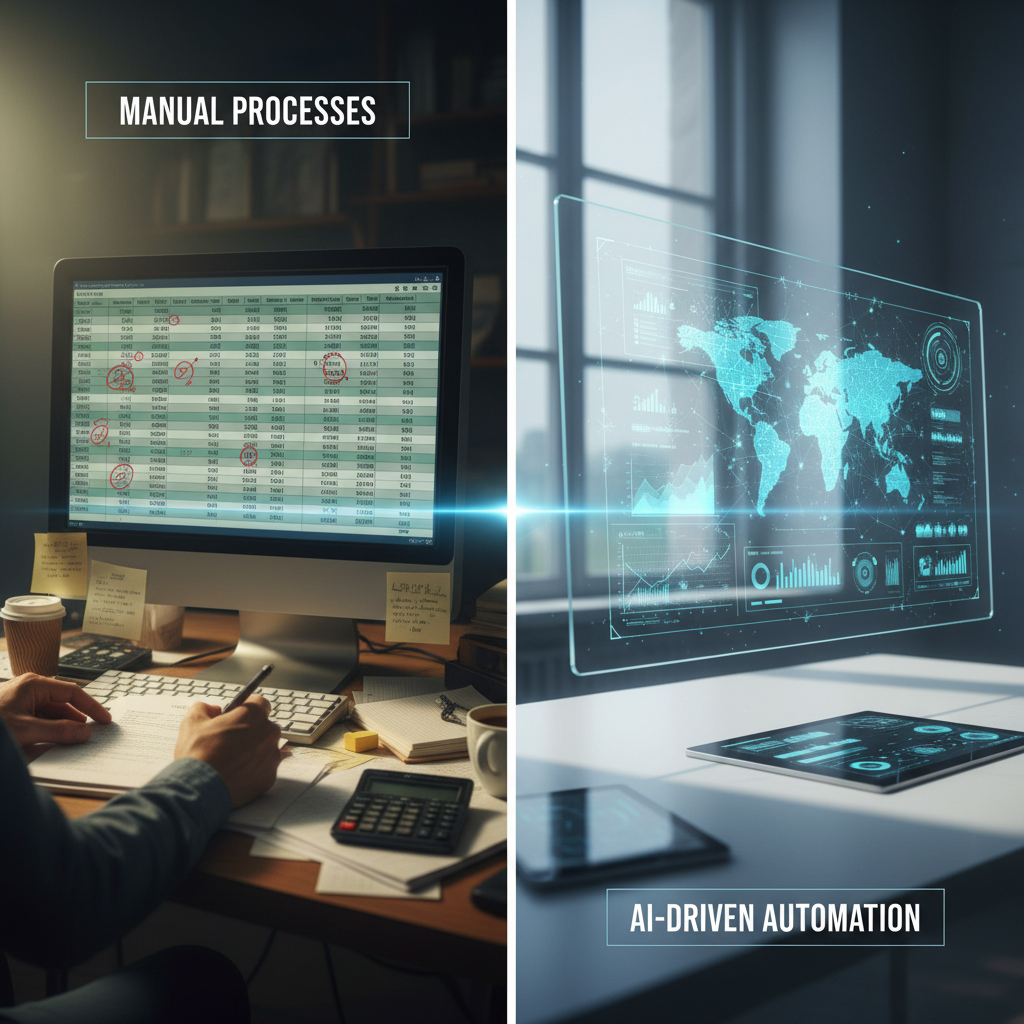
Navigating the complexities of the food supply chain requires a clear understanding of the tools at your disposal. Here’s a quick comparison of the fundamental differences between manual and AI-driven approaches:
- Speed:
- Manual: Slower, reliant on human processing times, prone to delays.
- AI Automation: Rapid, real-time data processing, instant insights and actions.
- Accuracy:
- Manual: Prone to human error in data entry, calculations, and decision-making.
- AI Automation: Highly accurate, minimizes errors through algorithmic precision and continuous learning.
- Cost:
- Manual: Ongoing labor costs, potential for higher waste due to inefficiencies.
- AI Automation: Upfront investment in technology, but significant long-term savings through optimized operations and reduced waste.
- Scalability:
- Manual: Limited scalability, increasing volume often requires proportional increase in human resources.
- AI Automation: Highly scalable, can handle vast increases in data and transactions without proportionate resource growth.
- Data Insights:
- Manual: Limited to human analysis, often reactive rather than proactive.
- AI Automation: Provides deep, predictive analytics, identifying trends and potential issues before they arise.
- Adaptability:
- Manual: Slow to react to market changes, supply disruptions, or regulatory updates.
- AI Automation: Adaptive, can quickly re-optimize plans based on real-time data and changing conditions.
- Traceability:
- Manual: Often fragmented, difficult to track products end-to-end, especially in recalls.
- AI Automation: Seamless, creating robust, often immutable records of product movement and conditions.
What Is Manual Management And When Does It Shine?
Manual management in the food supply chain refers to traditional methods relying primarily on human effort, experience, and tools like spreadsheets, phone calls, and paper-based records. This approach has historically been the backbone of the industry, particularly for smaller operations.
Key Characteristics of Manual Management
- Human-Centric Operations: Decisions are made by individuals based on their knowledge and intuition.
- Basic Tools: Relies on common office software, physical documents, and direct communication.
- Reactive Problem Solving: Issues are often addressed as they arise, rather than being proactively prevented.
Benefits of Manual Management (in specific contexts)
- Human Intuition and Relationships: Experienced managers can make nuanced decisions, especially in unpredictable situations or when strong personal relationships with suppliers and distributors are critical.
- Low Initial Cost: There’s minimal upfront investment in specialized software or hardware, making it accessible for bootstrapped start-ups.
- Flexibility for Small Scale: For very small, highly localized operations with minimal complexity, manual systems can be straightforward to set up and manage.
When To Choose Manual Management
While increasingly rare for anything beyond a micro-business, manual methods might be considered in these niche scenarios:
- Very Small, Local Operations: A local farm selling directly to a few restaurants or a small artisanal producer.
- Start-ups with Limited Capital: Businesses with extremely tight budgets for initial tech investment, though this quickly becomes a bottleneck for growth.
- Highly Bespoke, Low-Volume Products: Niche markets that require highly personalized, non-standard processes where automation might be overkill.
What Is AI Automation And When Does It Win?
AI automation in the food supply chain involves leveraging Artificial Intelligence, machine learning (ML), and advanced algorithms to manage, optimize, and predict various aspects of the supply chain. This approach moves beyond simple task automation to intelligent decision-making and continuous improvement.
Key Characteristics of AI Automation
- Data-Driven Decisions: AI analyzes vast datasets to provide insights, predictions, and recommendations.
- Predictive and Proactive: Identifies potential issues and opportunities before they fully materialize.
- Continuous Learning: ML models improve over time with more data, enhancing accuracy and efficiency.
- Integration: Connects various points of the supply chain, from farm to retail, creating a unified ecosystem.
Benefits of AI Automation
- Enhanced Efficiency: AI automates repetitive, time-consuming tasks, freeing human staff to focus on strategic initiatives and complex problem-solving. This significantly reduces operational overhead.
- Superior Accuracy: By minimizing human error in data collection, processing, and analysis, AI ensures greater data integrity, leading to better decision-making and fewer costly mistakes.
- Predictive Analytics: AI algorithms can forecast demand with remarkable accuracy, identify potential supply disruptions, optimize inventory levels, and even predict equipment failures, allowing for proactive adjustments.
- Real-time Visibility: Provides end-to-end transparency across the entire supply chain, enabling stakeholders to track products, monitor conditions, and react swiftly to changes.
- Cost Reduction: Optimizes routes, minimizes waste from spoilage or overstocking, reduces labor costs for manual tasks, and lowers overall operational expenses.
- Scalability: AI systems can easily handle increased volumes of data, transactions, and complexity as a business grows, without requiring a proportional increase in human resources.
- Improved Traceability and Food Safety: Creates an immutable, digital record of every product’s journey, crucial for compliance, quality control, and rapid response in case of a recall. This directly addresses stringent food safety regulations.
When To Win With AI Automation
AI automation is not just a competitive advantage; for many, it’s becoming a necessity:
- Large-scale Operations: Businesses with complex global or national networks, multiple suppliers, and distribution points.
- Growth-Focused Companies: Organizations aiming for rapid expansion, increased market share, and sustained competitive advantage.
- Industries with Strict Regulations: Food producers, distributors, and retailers facing stringent food safety, quality, and traceability requirements.
- Sustainability Initiatives: Companies committed to reducing waste, optimizing resource use, and improving their environmental footprint.
- Demanding Consumer Expectations: Businesses needing to meet consumer demands for freshness, transparency, and rapid delivery.

How Business Needs Influence The Decision
The choice between manual and AI automation isn’t about one being inherently “better” in all situations, but rather about which approach best aligns with your specific business needs, resources, and strategic goals. It’s a matter of fit.
Consider the scale of your operation. A small, local bakery with a single supplier and direct-to-consumer sales might find manual management sufficient initially. However, as that bakery expands to multiple locations, sources ingredients from diverse suppliers, and begins wholesale distribution, manual processes will quickly become a bottleneck, leading to inefficiencies and lost opportunities.
Complexity is another major factor. A simple supply chain with predictable demand can perhaps limp along with manual methods. But introduce multiple product lines, perishable goods, varying seasonal demands, international sourcing, and intricate logistics, and manual systems will buckle under the pressure. AI thrives on complexity, using algorithms to untangle intricate webs of data and provide clarity.
Budget and growth ambition also play a critical role. While AI automation requires an initial investment, its long-term return on investment (ROI) through reduced waste, optimized operations, and enhanced decision-making often far outweighs the costs. Businesses with strong growth aspirations recognize that investing in AI is investing in future scalability and competitive edge. Those with limited capital might start manual but should have a clear roadmap for technology adoption.
It’s also worth noting that a hybrid approach is common. Many businesses gradually transition to AI automation, automating key areas first while retaining some manual oversight or processes. The goal is to evolve towards an intelligent, data-driven supply chain that supports current operations and future growth.
Real Life Scenarios
Let’s examine how manual and AI approaches would handle common challenges in the food supply chain:
Inventory Management
- Manual: Staff physically count stock, update spreadsheets, and manually place orders when levels appear low. This process is time-consuming, prone to errors, and often results in either overstocking (leading to spoilage) or understocking (leading to lost sales).
- AI Automation: AI systems use real-time sales data, historical trends, seasonal patterns, and even external factors like weather forecasts to predict demand with high accuracy. They automate inventory tracking, trigger reorders when stock reaches optimal levels, and optimize storage, significantly reducing waste and ensuring product availability.
Quality Control & Traceability
- Manual: Relies on paper-based records, manual checks at various points, and human oversight. In the event of a quality issue or recall, tracing a product’s origin can be a complex, slow, and error-prone process, potentially leading to widespread product removal and reputational damage.
- AI Automation: Integrates sensor data from throughout the chain (temperature, humidity, freshness indicators) and uses blockchain technology to create an immutable, transparent record of every product’s journey. This enables real-time quality monitoring, instant identification of affected batches in a recall, and robust compliance with food packaging and safety regulations.
Demand Forecasting
- Manual: Forecasts are typically based on past sales data and human estimation, which can be heavily influenced by bias or incomplete information. This often leads to inaccurate predictions, causing either excess inventory or stockouts.
- AI Automation: AI algorithms analyze vast datasets, including historical sales, promotional activities, local events, social media trends, and even macroeconomic indicators. This allows for highly accurate, dynamic demand forecasting, optimizing production schedules and reducing unnecessary costs.
Supplier Relationship Management
- Manual: Involves extensive phone calls, emails, and manual record-keeping to manage supplier performance, contracts, and issues. Resolution is often reactive and can strain relationships.
- AI Automation: AI systems monitor supplier performance against key metrics, automate compliance checks, and proactively identify potential risks or opportunities. This fosters more efficient and transparent relationships, enhancing reliability and reducing potential disruptions.

Common Myths About Food Supply Chain Automation
Despite the clear advantages, several myths often deter businesses from exploring AI automation:
- Myth 1: AI replaces all human jobs.
Debunked: AI augments human capabilities. It automates repetitive tasks, freeing human employees to focus on strategic thinking, problem-solving, creativity, and customer relationships. It also creates new job roles in AI development, maintenance, and data analysis. - Myth 2: It’s only for huge corporations with massive budgets.
Debunked: While large enterprises are early adopters, AI solutions are becoming increasingly modular, scalable, and accessible for businesses of all sizes, including mid-market and even small businesses. Cloud-based SaaS models reduce upfront costs. - Myth 3: AI is too expensive and complex to implement.
Debunked: While there is an initial investment, the long-term ROI from reduced waste, improved efficiency, and enhanced decision-making often far outweighs the costs. Implementation can be phased, starting with critical areas. - Myth 4: Manual is more flexible and can react faster to sudden changes.
Debunked: Manual systems are slow to process new information and adapt. AI systems, especially those with machine learning, are designed to analyze real-time data and re-optimize plans almost instantly, making them far more agile in the face of disruptions. - Myth 5: Data security is a major risk with AI-driven systems.
Debunked: Reputable AI platforms and providers prioritize robust data security protocols, encryption, and compliance measures, often offering more secure environments than disparate manual systems.
So… Manual Or AI Automation?
The choice between manual and AI automation for your food supply chain is a pivotal one, with significant implications for your operational efficiency, profitability, and future growth. While manual methods may offer a low entry barrier for micro-operations, their limitations in scalability, accuracy, and data insights quickly become apparent as a business grows in complexity and volume.
For any food business looking to compete effectively in today’s demanding market, the verdict is clear: AI automation is not just an option, but a necessity. It empowers businesses to move beyond reactive problem-solving to proactive, predictive management. It reduces waste, ensures compliance, enhances customer satisfaction, and ultimately, drives sustainable success.
Prosessed understands these challenges. We specialize in AI solutions designed to streamline food supply chain operations, providing end-to-end visibility, predictive analytics, and automated decision-making that transforms your business. Curious about implementation? Check our FAQs for common questions and answers.
Ready to unlock the full potential of your food supply chain? Learn more about Prosessed and our mission, or ✨ Get Started Free today and begin your journey towards a more efficient, resilient, and profitable future.
Sources
- Supply Chain Management – Wikipedia
- Artificial Intelligence – Wikipedia
- Food Industry – Wikipedia
- Food Safety – Wikipedia
- Machine Learning – Wikipedia
FAQ
Q1: What is AI automation in the food supply chain?
AI automation in the food supply chain involves using Artificial Intelligence and machine learning algorithms to automate and optimize processes such as demand forecasting, inventory management, quality control, logistics, and traceability. It uses data to make intelligent, predictive decisions that enhance efficiency and reduce waste.
Q2: How does AI improve food safety and traceability?
AI improves food safety by monitoring conditions (like temperature and humidity) in real-time, identifying potential contamination risks, and predicting shelf-life. For traceability, AI-powered systems, often integrated with blockchain, create an immutable, digital record of every product’s journey from farm to consumer, enabling rapid and precise recalls if needed.
Q3: Is AI automation suitable for small food businesses?
Yes, AI automation is increasingly suitable for small food businesses. While historically associated with large enterprises, many modular, cloud-based AI solutions are now available at various price points, allowing smaller businesses to adopt automation incrementally and scale as they grow. The benefits of efficiency and waste reduction are valuable at any scale.
Q4: What are the main challenges of implementing AI in the supply chain?
Key challenges include the initial investment in technology, integrating new systems with existing infrastructure, ensuring data quality and availability, and training staff on new tools and processes. Overcoming these often involves careful planning, phased implementation, and choosing the right technology partner.
Q5: How long does it take to see ROI from AI automation?
The time to see a return on investment (ROI) from AI automation varies depending on the scale of implementation and the specific areas targeted. However, many businesses begin to see significant improvements in efficiency, waste reduction, and cost savings within 6-12 months, with the benefits compounding over time as the AI systems learn and optimize further.