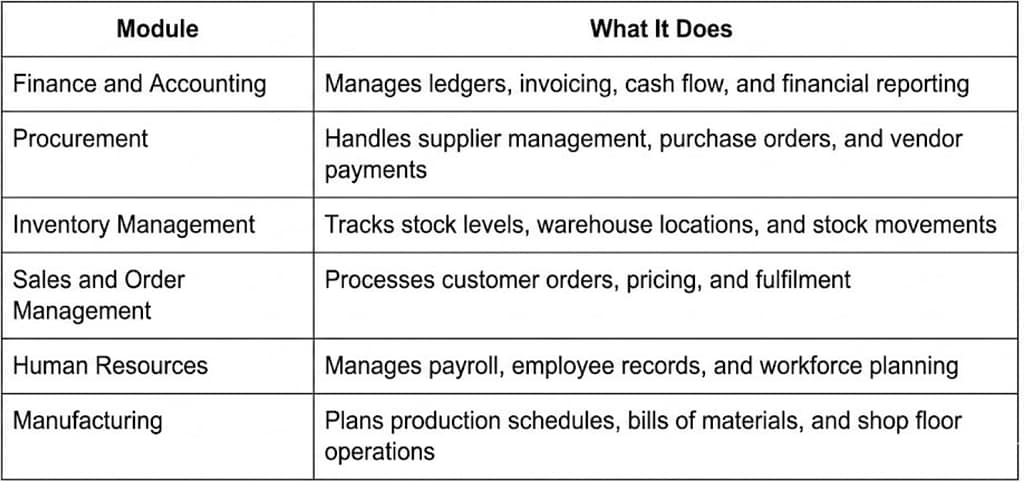
Inventory turnover ratio is the number of times your business sells and replaces its inventory during a period. The formula for food wholesalers is: Inventory Turnover Ratio = Cost of Goods Sold (COGS) / Average Inventory Getting this number right is the difference between fresh, profitable stock and a warehouse of write-offs.
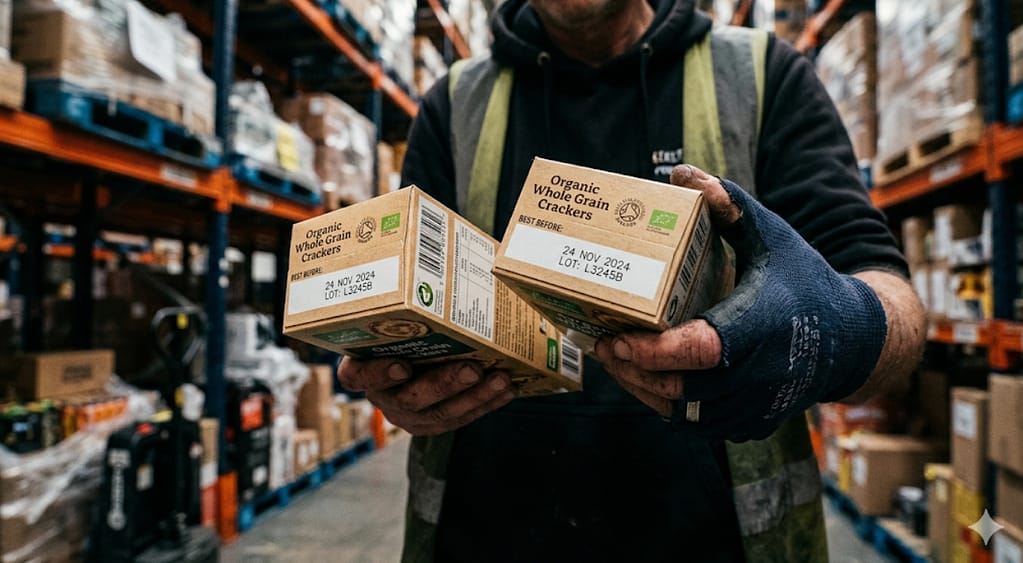
Table of Contents
- What is the Inventory Turnover Ratio?
- How to Calculate Inventory Turnover Ratio: Step-by-Step
- Inventory Turnover Ratio Calculator
- What is a Good Inventory Turnover Ratio?
- Days Inventory Outstanding (DIO): Related Metric
- How to Improve Inventory Turnover in Food Wholesale
- Frequently Asked Questions
- How Prosessed AI Helps Food Wholesalers Optimise Inventory Turnover
What is the Inventory Turnover Ratio?
Inventory turnover ratio is a measure of how many times a business sells and replaces its inventory during a certain period of time, often a fiscal year. A high ratio means the stock is faster, less expensive to hold and has more cash flow. A low ratio suggests overstocking, slow demand or poor buying decisions.
For food wholesalers and distributors, this metric carries even more weight than it does in general retail. Slow-moving stock does not just tie up capital. It spoils, expires, and generates write-offs that eat directly into margins. Understanding and actively managing your inventory turnover ratio is foundational to running a profitable food distribution operation.
This metric is even more important to food wholesalers and distributors than it is to general retail. Downward stock doesn’t just tie up capital. It goes bad, it goes stale, it causes write-offs that eat into margins. Knowing Inventory Turnover Equation inventory turnover ratio is the foundation of a successful food distribution business.
Inventory Turnover Ratio = Cost of Goods Sold (COGS) / Average Inventory
COGS is the direct cost of purchasing the goods you sell. It is the cost you pay to your suppliers for the products going out of your warehouse. Average Inventory smooths out fluctuations over the period. Average Inventory is calculated as:
Average Inventory = (Opening Stock + Closing Stock) / 2
So if your opening inventory value is $300,000 and your closing inventory value is $500,000, your Average Inventory is $400,000.
Alternative Formula Using Net Sales
Some businesses calculate inventory turnover using Net Sales rather than COGS:
Average Inventory / Net Sales = Inventory Turnover Ratio
This version is more typical of retail situations where COGS figures are not easily segregated from overheads, or of companies that use revenue figures to monitor performance. The COGS based formula is generally preferred for food wholesaling because it removes profit margins, giving a cleaner picture of how efficiently you are moving product through the supply chain. Only use the Net Sales version where COGS data is not available or for benchmarking to industry peers who report on a Net Sales basis.
How to Calculate Inventory Turnover Ratio: Step-by-Step
Step 1: Determine your COGS
Remove the Cost of goods sold from your profit and loss statement for the period you are measuring. This is the total cost of goods sold for the period, not your total purchases. Most accounting systems (QuickBooks, Xero, MYOB) will report this directly. This is your COGS number for a fiscal year.
Step 2: Locate Average Inventory
Take the value of your inventory at the start of the period (Opening Stock) and at the end of the period (Closing Stock). Mix them and divide with 2. If your warehouse system is capable of real-time inventory tracking, you can also average the monthly closing balances to get a more accurate figure over the course of a full year.
3. COGS divided by Avg. Inventory
Apply the formula. Divide your Cost of Goods Sold total by your Average Inventory value. What you are calculating is your inventory turnover ratio (ITR), a number that indicates the number of complete stock cycles you have run through your business in that time frame.
Step 4: Interpret the Result
Context matters. A ratio of 6 means you sold out and restocked 6 times in the year, or roughly every two months. Whether that is good or bad is entirely dependent on your product category. Here is a real food wholesale figure worked example
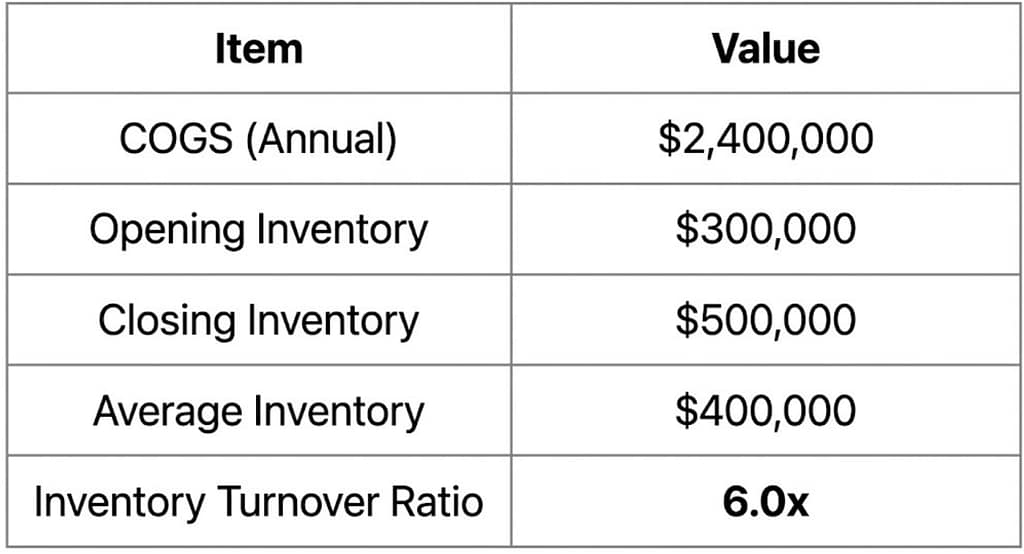
A ratio of 6.0x means this business is turning its stock every 60 days on average. For a dry goods wholesaler, this sits within an acceptable range. For a fresh produce distributor, it would signal a serious problem.
Inventory Turnover Ratio Calculator
To calculate your own ratio, you need three inputs: your COGS for the period, your Opening Inventory value, and your Closing Inventory value. Enter these into the fields below and the calculator will return your Inventory Turnover Ratio along with an interpretation based on food wholesale benchmarks.
Calculator Fields:
- COGS ($)
- Opening Inventory ($)
- Closing Inventory ($)
Output: Inventory Turnover Ratio + interpretation against food wholesale benchmarks
If you want to see how AI-powered inventory management can directly improve the number you just calculated, explore OrderIT by Prosessed AI, built specifically for food distributors managing complex, perishable stock.
What is a Good Inventory Turnover Ratio?
Inventory Turnover Benchmarks by Industry
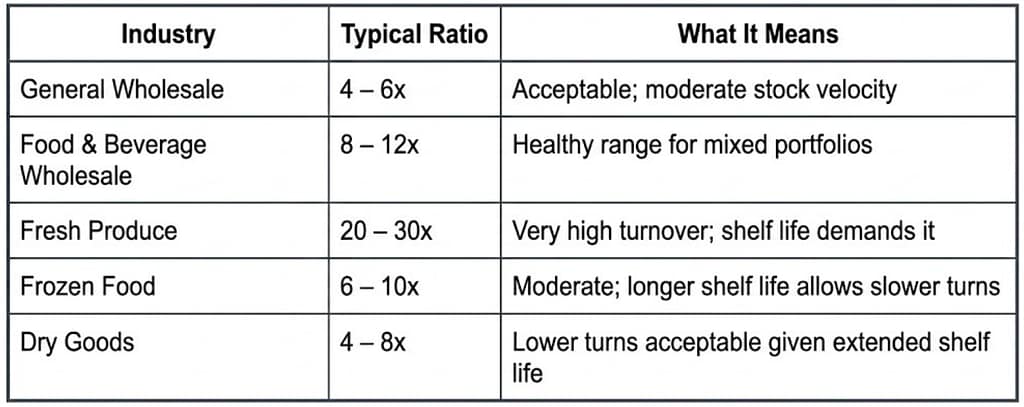
Once you have your ratio, the next question is whether it is good, acceptable, or a warning sign. Benchmarks vary significantly by product category, which is why food wholesale operations cannot rely on general commerce benchmarks.These are directional benchmarks. Your actual target ratio should account for your specific product mix, supplier lead times, and customer order patterns.
What Is Inventory Turnover Rate?
A low inventory turnover ratio shows that stock is not moving as fast as it should. The consequences for food wholesaling are grim. Slow moving products through your warehouse take longer than their shelf life allows creating spoilage risk and expiry write-offs. Money is tied up in inventory that is not generating revenue, storage and handling costs are accruing, and refrigeration or climate-controlled space is being consumed by product that should have been shipped already. A low ratio is often indicative of overstocking due to inaccurate demand forecasting, poor alignment with suppliers or a product assortment containing SKUs in declining customer demand.
What is a High Inventory Turnover?
A high inventory turnover ratio is usually a good sign. It means that your operation is running smoothly, stock is moving fast and cash is not being tied up in your warehouse. For food businesses handling perishables, a high turnover ratio is not aspirational but a necessity. But a ratio that is too high can create problems of its own. Consistently turning stock faster than you can keep up with your reorder cycle puts you at risk for stockouts, missed sales, and customer frustration. You want a ratio that indicates that your stock is being well managed and is not creating supply gaps.
Days Inventory Outstanding (DIO): Related Metric
Days Inventory Outstanding (DIO) is the companion metric to inventory turnover and one that food wholesalers should track alongside the ratio itself.
DIO = 365 / Inventory Turnover Ratio
Using the worked example above, a turnover ratio of 6.0x gives a DIO of approximately 61 days. This tells you that it takes your business 61 days, on average, to sell through its inventory.
For food businesses, DIO has a very practical application. If your DIO exceeds the shelf life of your products, you have a structural problem. A fresh produce distributor with a DIO of 25 days and products that expire in 14 days is, by definition, generating waste. DIO brings the inventory turnover ratio down to a concrete, operationally actionable number that can be compared directly against product shelf life data.
How to Improve Inventory Turnover in Food Wholesale
1. Adopt AI-Driven Demand Forecasting
The most common cause of poor inventory turnover in food distribution is overstocking, which is almost always due to poor demand forecasting. When buying decisions are driven by intuition, historical averages or manual spreadsheet models, the result is buying too much of the wrong products, at the wrong time. AI powered demand forecasting analysis of actual order history, seasonal patterns and buyer behaviour to provide accurate purchase recommendations before you place a supplier order. Prosessed AI’s OrderIT uses this approach to help food distributors reduce overstock by 15 to 20 percent, directly improving turnover ratios. You can also read more on this topic in our guide to demand forecasting for food wholesalers.
2. Use FEFO (First Expired, First Out) Fulfilment
FEFO is the fulfilment standard for any business managing products with expiry dates. Unlike FIFO (First In, First Out), which prioritises dispatch order by arrival date, FEFO ensures that the product closest to its expiry date always ships first, regardless of when it arrived. If you don’t have FEFO batch tracking, then warehouse teams will pick the stock that’s most accessible and this can mean that older product sits there until expiry. To implement FEFO in your warehouse, you need to track inventory at the batch level and tie expiry dates to pick sequences. For a comparison of fulfilment methods, see our related page FIFO vs LIFO for food distributors (coming soon).
3. Detect and Liquidate Slow-Moving SKUs
In every food wholesale business there are SKUs that slow down the average portfolio turnover. Those slow moving lines are typically hidden deep within the aggregate reporting and only appear when you drill down to SKU-level inventory performance. A review of slow-moving products should routinely identify products whose DIO numbers are greater than the shelf life, SKUs not sold within a defined period, and lines with stock on hand that is significantly greater than expected demand. Once identified, slow movers must be dealt with through promotional pricing, liquidation into secondary markets or removal from the active catalogue, so as to release warehouse space and purchasing capacity.
4. Reorder Points Tightened with Real-Time Inventory Info
Static calculations or monthly stock counts will always lag behind actual demand and reorder points. If your procurement team is relying on inventory data that is even a few days old, they are making buying decisions based on an inaccurate picture of what is actually in the warehouse. This is completely changed by real-time inventory visibility. If your re-order points are connected to live stock levels, orders are triggered at exactly the right time, reducing both stockouts and overstock situations. Prosessed AI’s OrderIT platform provides real-time inventory tracking that feeds directly into reorder logic, ensuring your purchasing decisions are always based on current stock reality rather than outdated snapshots.
5. Align Procurement Cycles to Actual Demand
Many food wholesalers operate to a fixed procurement cycle, putting purchase orders out on a weekly or monthly basis on a schedule rather than in response to what the market is doing. If demand from customers varies with the seasons, or by product category or even by external events, then a fixed cycle of procurement means you are always buying too much at slow times and too little at peak times. You need to link the buying decision to real sales velocity data to align your procurement cycle to demand signals. ProcurePro by Prosessed AI is built for exactly this, enabling demand-driven procurement that adjusts purchasing frequency and volume based on what your customers are actually ordering, rather than a calendar-driven rhythm.
Frequently Asked Questions
The formula for inventory turnover ratio is:
The standard formula for the inventory turnover ratio is as follows: Inventory Turnover Ratio = Cost of Goods Sold (COGS) / Average Inventory. Average Inventory = (Opening Stock + Closing Stock)/2; In some businesses, Net Sales can substitute COGS, but for food wholesale businesses, the COGS formula is a better indicator of operational stock efficiency.
What is a good inventory turnover ratio for food distributors?
For general food and beverage wholesale, an 8 to 12x ratio is healthy. Fresh produce distributors should be targeting 20 to 30x for the very short shelf life of their products. Frozen food operations typically run in the 6 to 10x range, while dry goods distributors are usually in the 4 to 8x range. The right benchmark depends on your unique product mix and shelf life properties of your inventory.
How frequently should I calculate inventory turnover?
Most businesses calculate inventory turnover on an annual basis for financial reporting purposes, but food wholesalers benefit from calculating it monthly or even weekly for high-velocity product categories. Tracking the ratio at a shorter frequency allows you to identify deteriorating stock performance before it becomes a spoilage or cash flow problem.
What is the difference between inventory turnover and days sales of inventory?
Inventory turnover (or inventory turns) measures how many times you sell through your stock in a period, expressed as a multiple (e.g., 8x). Days Sales of Inventory (DSI), also known as Days Inventory Outstanding (DIO), converts that multiple into days and tells you how long it takes to sell through your average inventory level. DIO = 365 / Inventory Turnover Ratio. Both metrics measure the same underlying dynamic, but DSI is often more intuitive for operational teams because it can be compared directly against product shelf life.
How does AI improve inventory turnover?
AI improves inventory turnover by eliminating the inaccuracy that causes most turnover problems in the first place. AI-powered demand forecasting uses historical order data, customer buying patterns, and seasonal signals to generate precise purchase recommendations, preventing both overstock (which slows turnover) and understock (which causes missed sales). AI also enables real-time inventory monitoring that triggers reorders at exactly the right moment, and batch-level tracking that enforces FEFO dispatch to minimise expiry write-offs. The result is a tighter, faster-moving inventory with less waste and better cash performance.
How Prosessed AI Helps Food Wholesalers Optimise Inventory Turnover
Inventory turnover is not a metric you improve by watching a dashboard. It improves when the decisions that feed it change. Prosessed AI gives food wholesalers the tools to make better decisions at every point in the inventory cycle.
OrderIT’s AI demand forecasting looks at your real order history and customer behaviour to make purchase recommendations that reduce overstock by 15 to 20 percent, one of the most direct levers to improve your turnover ratio. Batch-level tracking and FEFO enforcement (first expired, first out) ensures that product that is closest to its expiration date ships first. This helps to reduce write-offs that artificially inflate your average inventory value without contributing to COGS. Real-time inventory visibility means your reorder points are connected to live stock data, not a snapshot from last week’s count. ProcurePro synchronises your procurement cycles to actual demand, so that your buying decisions are driven by what your customers are ordering, not by a calendar.
This results in higher stock velocity, lower carrying costs, and an inventory turnover ratio that will reflect a truly efficient operation.