Tag: wholesale automation

  • Best Software for Food Wholesalers and Distributors

    Running a food wholesale business means dealing with chaos every single day. Juggling items that spoil quickly sits alongside wild price swings from suppliers. Orders come in different currencies, while customers send messages through WhatsApp without warning. Sales teams stick to old spreadsheet habits instead of modern tools. Mistakes creep in easily when systems barely hold together. Wasted time turns into lost money quicker than expected.

    Midnight rolls around faster when you are stuck typing instead of clicking. Firms tracking orders by hand face paperwork loads forty to fifty percent heavier compared to teams running on tailored tools. Gains pile up elsewhere – think client growth, sharper pricing talks, or simply shutting down work earlier. What eats hours one day adds up to lost chances over weeks.

    Here’s the catch: plenty of programs labeled for wholesale trade actually ignore food needs. Instead of handling spoilage right, standard stock apps fall short. Even strong ERPs demand endless setup time along with sky-high fees. Most setups also expect buyers to order online – forgetting how many still send voice messages via chat.
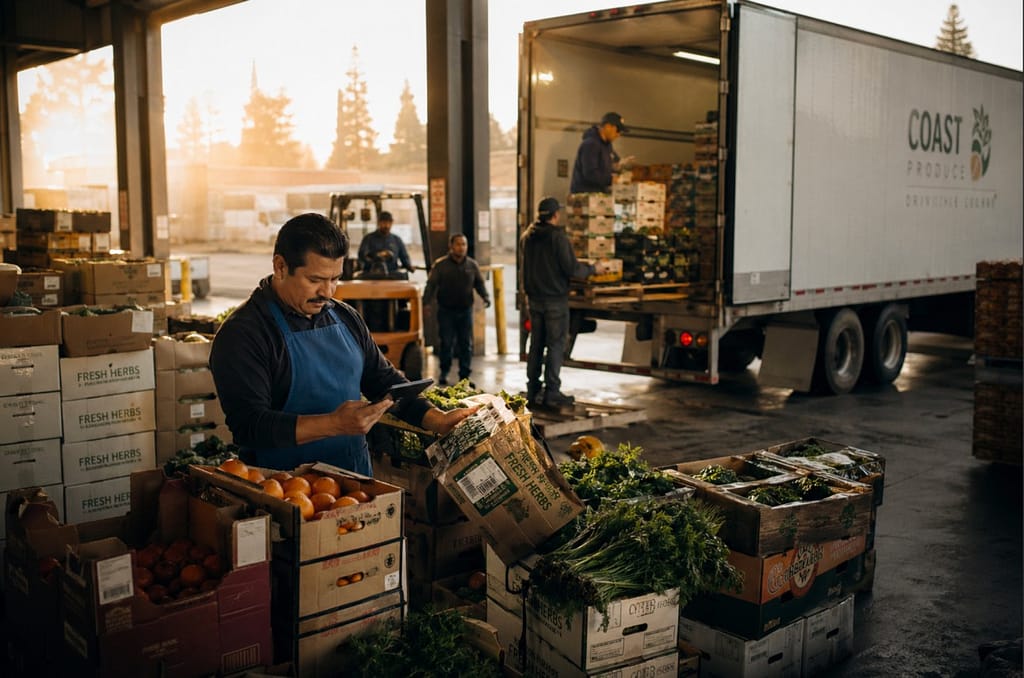
    This guide walks through seven top tools built for food wholesalers in 2026 – spelling out which teams benefit most, yet where each one falls short. While some fit big distributors well, others suit small operations better; not every platform delivers equally across the board. Each option shows strengths, though specific needs shape whether it clicks or misses entirely.

    Table of Contents:

    1. What to Look For in Food Wholesale Software
    2. The 7 Best Software for Food Wholesalers (2026)
    3. Head-to-Head Comparison Table
    4. How to Choose the Right Software for Your Business Size
    5. FAQs
    6. The Bottom Line

    What to Look For in Food Wholesale Software

    Most wholesale systems aren’t made for how food moves out the door. When trucks are loading at 6 AM, small flaws in the software start screaming for attention. Knowing which features matter most makes it easier to tell them apart before things get hectic.

    AI-powered order management is no longer a premium feature.Top systems in 2026 create bills automatically, recommend how much to restock, catch odd prices, while also pulling orders straight from WhatsApp chats. Without built-in smart features, you’ll end up patching gaps with extra steps.

    Food-specific workflows matter more than you might expect. Food importers need tools that handle batch details, track expiration dates, manage variable weights on invoices, while also monitoring stock inside containers. Standard inventory systems usually lack such features right away.

    WhatsApp and chat-based ordering is how most people buying food in growing markets prefer to place orders. Logging into a system just does not catch on when it skips their usual way of chatting. Starting elsewhere rarely sticks if it ignores daily habits.

    Multi-currency and global trade support is essential when dealing with international suppliers or cross-border sales. Working out total delivered costs becomes easier when duties are tracked automatically. Dealing with vendors using foreign money works better without extra accounting steps getting in the way. Keeping everything together saves time and reduces errors along the way.

    Mobile-first design matters for your field sales team and for warehouse staff who are not sitting at a desk. If the mobile experience is clunky, your team won’t use it.

    Realistic pricing and implementation time are worth evaluating honestly. Take a system running fifty grand with half a year just to launch – that kind of weight slows down most food distribution businesses. What hits fast makes a difference.

    Now, here are the seven tools worth evaluating.

    The 7 Best Software for Food Wholesalers (2026)

    1. Prosessed (OrderIT) – Best for Food Wholesalers and Importers

    What sets Prosessed apart? It’s made just for people moving food across borders – importers, exporters, shippers. The main tool, called OrderIT, runs the entire ordering process start to finish. Intelligence drives it, woven into every step along the way.

    Here’s what sets Prosessed apart – built on real wholesale needs, not guesses from someone behind a screen. When orders arrive through WhatsApp? OrderIT pulls them straight in. Need invoices made automatically right after an order hits? It handles that without delay. Pricing shifts depending on volume, buyer level, or money type? Already part of the system. Wondering if you’ll get stuck with stock nobody wants? Forecast tools help avoid exactly that.

    Machine learning powers what some might call an AI layer – no empty branding here. Instead of guessing when supplies run low, past sales help shape smart restocking alerts. Unusual price tags or odd order sizes get noticed early. Mistakes that could drain budgets often start small, but spotting them does not have to be slow.

    Most platforms struggle when currencies shift, yet this one adjusts without extra steps. Tracking single containers matters more than people admit – it sees what others overlook. Anyone dealing with overseas food shipments knows timing gets messy, especially nights and weekends. Orders pop up whenever buyers decide, no schedule required. Juggling many products feels smoother here than almost anywhere else. When your job means handling hundreds of items across far-flung partners, simplicity becomes critical. It fits those moments when chaos seems normal.

    Best for: Food wholesalers, importers, exporters, and distributors of all sizes
    Standout features: AI order entry via WhatsApp, dynamic pricing, demand forecasting, multi-currency support
    Limitation: Focused on food and FMCG, not a fit for non-food wholesale

    Start a free trial with Prosessed or book a 20-minute demo to see OrderIT in action.

    2. Cin7 – Best for Multichannel Wholesale

    Cin7 handles stock and orders reliably, especially if you sell through more than one place – like stores, online, or bulk buyers. Because it connects easily with many other tools, managing what’s in stock becomes smoother over time. Purchase requests get organized without much fuss. Reports come together clearly, shaped by real usage rather than guesswork. Features have had room to grow, so they fit how actual teams work.

    Food distributors might find Cin7 lacking when it comes to smart tools built for their needs. Instead of artificial intelligence features, users get basic operations without much guidance. Messaging through WhatsApp isn’t supported right out of the box. Predicting what stock will sell? That function doesn’t exist here either. Workers in storage areas often struggle at first because the layout feels confusing. When dealing with items that expire quickly and inventory that moves fast, missing automated support slows everything down.

    Still, when your wholesale operation spans multiple channels – especially beyond just food – a system like Cin7 might fit well, especially with its links to online stores and bookkeeping apps. Curious how it holds up next to software made only for food businesses? Check the Cin7 Alternative guide for a closer look.

    Best for: Multichannel wholesalers with mixed product categories
    Standout features: Strong integrations, inventory management, multichannel support
    Limitation: Steep learning curve, no AI features, not built for food-specific workflows

    3.QuickBooks Commerce – Best for SMBs with QuickBooks

    QuickBooks Commerce fits small wholesale shops already using QuickBooks every day. Because the link to accounting works without hiccups, shifting data feels smooth. Teams lacking tech experts won’t struggle either, since the layout stays clear and straightforward. What stands out is how little setup it demands just to get going.

    Once things get complicated, gaps start showing up. Workflows built just for food? Missing entirely. Catch-weight billing isn’t there, nor does it track when batches expire, plus messaging orders via WhatsApp won’t work here. International trade tools feel like an afterthought – barely enough for basic needs. The system feels shaped by local small-scale selling, not the messy reality of moving goods across borders, which most importers deal with every day.

    Starting with spreadsheets? Then moving into QuickBooks might make sense for a small local distributor. Yet when goods come from abroad – or drivers hit the road selling full time – this setup won’t stretch far.

     Best for: Small domestic wholesalers already using QuickBooks
    Standout features: QuickBooks integration, clean interface, affordable pricing
    Limitation: Limited food-specific features, poor global trade support, no AI capabilities

    4. NetSuite ERP – Best for Large Enterprises

    One big reason NetSuite stands out? It handles money tracking, stock levels, deliveries, customer records – all inside one system. When you run a major food delivery operation and have tech staff ready, plus years to set things up, this kind of setup makes sense. What holds it together isn’t magic – it’s how everything links without extra tools.

    Heavy demands trail close behind its capabilities. Most companies spend half a year or longer getting NetSuite up and running, often paying big money long before subscriptions start adding up. Screens feel packed. Tweaking anything usually means calling in coders. Justifying the full expense proves tough when you’re a medium-sized food distributor.

    Most companies making under roughly fifty million dollars each year find NetSuite too much. Sure, it brings room to adapt how things run. Yet that comes with added layers that slow decisions down.

     Best for: Large enterprise food distributors with dedicated IT resources
    Standout features: Full ERP coverage, finance, inventory, supply chain, CRM
    Limitation: Very expensive, long implementation time, excessive complexity for most food wholesalers

    5. Pepperi – Best for FMCG Field Sales Teams

    Out there among tools for sales teams, Pepperi fits right into the daily grind of people who sell face to face. Instead of juggling paper or spreadsheets, reps get a clean way to show products, take orders on tablets, while managers track where each person goes. Picture someone walking into a convenience store, pulling up pricing and stock levels in seconds – that part works smoothly. If your business sends lots of sellers to small stores every day, this handles what they actually do on the ground. Not flashy, just gets the routine tasks done without breaking down.

    Out there among food importers and distributors, weak spots show up most in moving goods and running daily ops. While Pepperi focuses on sales tools, it skips handling shipping containers, following incoming freight, or streamlining office tasks behind the scenes. When your operation runs on tight logistics and demands that orders talk directly to warehouse activity, relying on Pepperi means patching things together after the fact.

    For a comparison of Pepperi against platforms with broader operations coverage, visit our Pepperi Alternative page.

    Best for: FMCG companies with large field sales teams
    Standout features: Mobile catalog, route management, B2B ordering
    Limitation: Weak logistics and operations features, not suited for importers managing containers

    6. Fishbowl Inventory – Best for Warehouse-Heavy Operations

    Inside your warehouse, Fishbowl keeps tabs on what goes where. Tied directly into QuickBooks, numbers flow without double entry. Moving goods? It logs every shift across shelves and zones. Purchase jobs get lined up neatly, never lost in spreadsheets. Companies making or shipping lots of physical things lean on it when space gets busy. Complexity doesn’t scare it – clutter meets order.

    Fishbowl falls short when it comes to handling sales tasks with smart tech. Instead of automated ordering, you get nothing driven by artificial intelligence. Messaging through WhatsApp? Missing entirely. Predicting what stock sells when? Not built in. The system focuses on storage, not full-cycle delivery workflows. Suppose tracking inventory is your priority and sales systems are already running elsewhere. Then Fishbowl might slot right into place. But if everything must connect seamlessly, prepare to link disjointed software pieces.

    Best for: Warehouse-heavy operations with existing sales tools
    Standout features: Inventory tracking, bin management, QuickBooks integration
    Limitation: No AI capabilities, no sales automation, not suited as a standalone distribution platform

    7. Unleashed – Best for Food Manufacturers

    What stands out about Unleashed is how it supports food makers juggling recipes, batches, and stock levels. Instead of just counting items, it follows ingredients from delivery through to final product. Because its flow matches real kitchen rhythms, many find it smoother than standard systems. While others struggle with complex ingredient chains, this one keeps pace without extra steps. Finished goods get logged just as carefully as what goes into making them. Through each stage, the updates happen quietly, without delays or manual checks piling up. Even when output shifts week to week, the record keeping holds steady. Since every batch ties back to source materials, tracing stays simple. Rather than forcing processes into rigid boxes, it bends slightly to fit actual work patterns. Most tools lag behind production speed – this doesn’t.

    Most food distributors won’t find Unleashed quite right. Built for making things, not moving them, it leans heavily on production workflows instead of supply chain moves. Forecasting needs outside tools since there’s no built-in intelligence. Runs well if you make products and also sell them. But when your work is bringing in goods or shipping out bulk orders – no factory involved – something else here fits tighter.

    Best for: Food manufacturers who distribute their own products
    Standout features: Bill of materials, batch production tracking, inventory management
    Limitation: No native AI, demand forecasting requires add-ons, limited distribution-specific features

    Head-to-Head Comparison Table
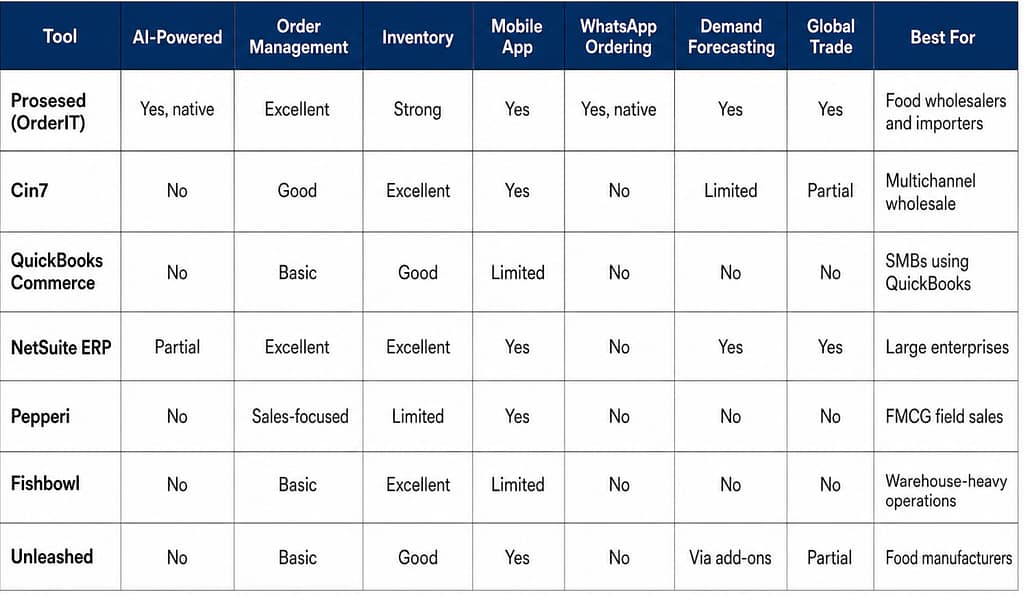
    The pattern here is consistent. Prosessed is the only platform that checks the boxes food wholesalers actually need: AI-powered automation, WhatsApp ordering, demand forecasting, and global trade support, all in a single tool built for the food sector.

    If you’re ready to see how it works in practice, start a free trial at Prosessed with no card required.

    How to Choose the Right Software for Your Business Size

    Not every food wholesaler has the same needs. Here is a practical framework for narrowing down your options based on where your business is today.

    If you’re a small distributor or just getting off spreadsheets: Pick whatever fixes your worst headache first. Most tiny food shops struggle with tracking orders and sending bills. Try Prosessed’s free run – it uses smart software to handle orders, no months of setup needed. If you already use QuickBooks for money stuff, their Commerce tool works fine too.

    If you’re a mid-sized importer or distributor with a field sales team: One spot where sales teams, operations, and buyers link up matters now. Messaging through WhatsApp for orders shows up as key – so does phone-friendly layout along with predicting what sells. Built right into its bones, Prosessed fits this shape well. When stock needs stretch past meals and go channel-crazy, give Cin7 a look.

    If you’re a large enterprise with dedicated IT resources: When it comes to managing large-scale operations, NetSuite keeps up – though expect a heavy lift during rollout. If big-company features matter but cost doesn’t have to, consider Prosessed: smart systems ready fast, built like premium tools minus the long wait.

    If your main business is food manufacturing: What sets Unleashed apart is how it manages production tasks – few others match its flow. When stock control is the main hurdle, Fishbowl steps into the picture.

    Not sure which plan fits your operation? Prosessed’s team can walk you through your options.

    For more detailed guidance on selecting the right platform for your distribution setup, read our guide on how to choose the right wholesale distribution software and our roundup of the top AI ordering systems for modern food wholesalers.

    FAQs

    What is the best software for food wholesalers?

    When it comes to food wholesalers in 2026, Prosessed (OrderIT) stands out simply because it started life made just for them. Built from the ground up for food distributors, its core knows what matters. Instead of forcing round pegs into square holes, it flows naturally with how these companies actually work. While systems such as Cin7 or NetSuite can technically keep up, they weren’t shaped by daily delivery runs or perishable inventory rhythms. 

    What is food distribution software and what does it do?

    Start here if you move goods from vendor to buyer. One system handles ordering steps plus keeps count of what sits on shelves. Information travels straight from sales folks into storage areas, then lands neatly in billing sections. No retyping needed when updates happen somewhere else. Teams swap messages about stock levels using shared records instead of old spreadsheets. Predictions for future needs come from patterns already stored inside the tool. People who send supplies get tracked just like those receiving them. Smooth links between each part cut down delays that slow everything else. What gets sold shows up instantly where it matters most.

    Is there software built specifically for food importers and exporters?

    True. Among systems made for those moving food across borders, none shows intent more plainly than Prosessed. Built-in abilities – such as monitoring stock by container, setting prices in various currencies, letting buyers send orders through WhatsApp, handling variable weights during invoicing – set it apart from standard distribution software. Typical inventory or enterprise platforms lump groceries in with everyday goods, ignoring critical needs tied to spoilage risks and complex overseas logistics.

    How is AI used in wholesale distribution software?

    Orders arriving by WhatsApp or email get processed without human hands. Instead of people checking each one, software reads them and acts. Invoices appear automatically once details are confirmed. Odd requests – like strange prices or big volumes – trigger alerts. Past buying trends help guess when stock will run low. Pricing shifts depending on who the buyer is or what the market does. At the center of tools such as Prosessed, intelligence isn’t tacked on – it runs everything from within.

    What’s the difference between an ERP and a wholesale management platform?

    One system, such as NetSuite or SAP, handles everything from money matters to people tasks, shipping stuff around, making goods – pretty much all big parts of running a company. These systems pack serious power yet often come with high prices and tricky setup processes. Instead of going broad, some tools go deep – for example, Prosessed focuses only on what distributors need: moving orders smoothly, tracking stock levels, setting correct prices, keeping buyers informed. Most food-focused wholesale businesses find better results quicker using specialized software like that, spending less cash overall – even when linking up with current bookkeeping programs already in place.

    The Bottom Line

    One step ahead in 2026 stands a platform shaped by how food moves through supply chains. At the top, only a few bulky ERP systems remain – costly, hard to manage. Meanwhile, scattered across smaller operations are basic tracking apps, never made with perishable goods in mind. What sets apart the real solution is its design rooted directly in daily distribution reality.

    Starting out as a food wholesaler, importer, or distributor? Prosessed fits just there. No credit card needed for the free trial – setup wraps up in days, sometimes even less.

    If your business demands tight multichannel control, Cin7 might catch your eye. When big companies can handle the cost and tech setup, NetSuite still sets the bar. Everyone else finds themselves stuck – generic tools just don’t cut it next to software made for food distribution.

    Start your free Prosessed trial today and see the difference a food-first platform makes.
  • 30 B2B Wholesale Statistics That Prove AI Is No Longer Optional in 2026

    Come 2026, most business buyers belong to the millennial group – three out of four, Raised on instant online purchases and live delivery updates, delays feel strange to them. Waiting three full days for a quote stuck inside a PDF? That kind of slowdown won’t fly. Any company dragging its feet will lose those customers fast – someone else always stands ready to move quicker.

    This isn’t forecasting. This reflects today’s reality. For wholesalers relying on spreadsheets, handwritten orders, or instinct-driven buying – these 30 figures aren’t hints at what’s coming. They spell out how things already stand.

    Table of Contents

    1. Key Takeaways
    2. The B2B Wholesale Market in 2026: Scale and Growth
    3. B2B Buyer Behavior Has Already Changed
    4. AI Adoption in B2B Wholesale: Where the Industry Stands
    5. What AI Is Actually Delivering for Wholesale Operations
    6. What Buyers Now Expect from AI-Enabled Vendors
    7. The Cost of Not Acting
    8. Food and Wholesale Distributors Face New Conditions
    9. Frequently Asked Questions

    Key Takeaways

    • Eighty percent of business buyers now connect through online platforms, pushing worldwide B2B e-commerce to $36 trillion by 2026, nearly six times the value of consumer-focused sales.
    • Nearly two out of three business customers prefer completing purchases entirely on their own, with no salesperson involved, as digital access quietly reshapes how decisions get made.
    • Smart systems cut buying expenses by around fifteen percent and push efficiency up by nearly a third, not magic, just smarter processes at work.
    • Around four out of five wholesale distributors are turning to artificial intelligence for clearer visibility into their supply chains.
    • Businesses using artificial intelligence hit their revenue targets far more often, and the gap between adopters and those without such tools shows up sharply in financial outcomes.
    • Nine out of ten businesses are shifting budgets toward artificial intelligence and machine learning through 2027, with spending trends showing a clear and accelerating tilt in that direction.

    Section 1: The B2B Wholesale Market in 2026: Scale and Growth

    Before we get into AI specifically, it helps to understand the scale of what is at stake. The B2B wholesale market is not a niche. It is the largest commercial market on earth.

    Stat 1: The global B2B ecommerce market has reached $36 trillion in 2026

    Picture this – the world’s business-to-business online trade hits $36 trillion by 2026, says the International Trade Administration,. Nope, that number isn’t mistaken. While consumer-focused digital sales trail behind at about $5.5 trillion, the B2B arena runs way ahead. Six times bigger, actually.

    For wholesalers, here’s the reality: your space is the biggest commercial arena on Earth. Forget wondering if going digital pays off. When you’re working at this level, tiny improvements – just one percent – bring in sums larger than what most companies make in a full year.

    Stat 2: The market is projected to reach $61.6 trillion by 2031

    One out of every five dollars traded between businesses globally may happen online by 2031, suggests Mordor Intelligence.That kind of rise comes down to a steady climb near 10.84% annually. Before long – roughly half a decade – the total value might sit close to twice today’s number.

    For wholesalers, this moment offers room to move ahead of the pack by building digital tools and testing how smart software works. Getting started early means gains pile up quietly while the field keeps stretching forward.

    Stat 3: B2B represents 86.6% of all US ecommerce

    Last year, The US B2B ecommerce market reached $9.69 trillion in 2024, That number makes up nearly 87 percent of all online trade there. Many people still think buying stuff online means shopping like consumers do. But that idea misses reality by a wide mark. Business transactions between companies dominate what happens on the web.

    Here’s what unfolds for wholesalers: Consumer ecommerce habits, along with shifting buyer demands and market pressures, are spilling into wholesale spaces. When sellers ignore Amazon-style ease, thinking it doesn’t apply, they overlook how customer hopes really form.

    Stat 4: Digital channels now account for 56% of B2B revenue, up from 32% in 2020

    Five years back, Digital revenue share in B2B has gone from 32% in 2020 to 56% today. This isn’t slow growth piling up over time. What we’re seeing reshapes the entire setup, built fast, not stretched out. The change didn’t whisper; it arrived loud, clear, and complete.

    Here is what it looks like for distributors: When most of your income comes from voice conversations, handwritten tickets, face-to-face meetings – your rhythm isn’t just old-fashioned. It trails what others already do.

    Stat 5: The B2B wholesale market has grown 116% since the start of this decade

    Ever since 2020, the B2B ecommerce space expanded by nearly 116%. That surge mostly landed in the laps of companies running sharp digital systems. Firms still relying on older setups haven’t vanished – yet each year they fade a bit more into the background.

    For wholesalers, here’s what’s unfolding: momentum keeps building. Companies putting money into digital tools plus artificial intelligence today aren’t just matching current trends. They’re aiming ahead, shaping moves before the shift happens.

    Section 2: B2B Buyer Behavior Has Already Changed

    Right here, these numbers matter more than any others you’ll see. That’s why – they show who’s really buying from you at this moment. Forget imagined customers down the line. These stats reflect real folks hitting purchase buttons today.

    Stat 6: 61% of B2B buyers prefer a rep-free buying experience

    One way people buy things changed, according to a Gartner’s June 2025 survey. Most business shoppers now skip talking to salespeople altogether. Researching products happens on their own time, followed by setting up what they need. Figuring out cost comes next, all before hitting buy – no help asked. The whole process runs without speaking to another person.

    Here is what happens now for distributors: Salespeople matter when deals get tricky or trust needs building. Yet during repeat orders, looking through product lists, or standard buys, customers prefer skipping the chat. Should your system make contact unavoidable, they simply switch to another where it isn’t.

    Stat 7: 73% of B2B buyers are millennials

    According to LinkedIn’s 2025 B2B Buyer Report millennials fill 73 percent of buyer roles, nearly half the final say in decisions. Not once do they open phone books. Instead, searching online leads them to weigh options quietly before choosing alone.

    Here is what unfolds for wholesalers. Selling rooted in connection remains key. Yet that bond now begins on the web, unfolding across screens. A clumsy online presence? It becomes a barrier. Younger buyers often walk away before even saying hello. Their judgment forms early, shaped by how smoothly they navigate your digital space.

    Stat 8: 80% of B2B sales interactions now occur in digital channels

    By 2026, most business-to-business buying moments shift online – no surprise there. Think automated storefronts where customers browse alone. Picture product listings you explore without a rep breathing down your neck. Chat tools pop up when questions arise. Marketplaces host entire deals start to finish. Gartner projects sees four out of five exchanges happening through screens by then.

    Most purchase decisions start without any help from your sales staff. That reality hits hard when you see four in every five customer searches take place outside your reps’ reach. Think about it – your website, how smooth your system works, even smart tools running quietly in the background – they’re doing the talking long before a human ever gets involved. These pieces aren’t support. They are the front line. Buyers spend their time there, forming opinions while you’re not watching.

    Stat 9: 75% of B2B buyers and sellers prefer digital self-serve over in-person meetings

    McKinsey research shows that more than 75% of B2B buyers and sellers now prefer digital self-serve and remote interactions over in-person meetings, and they rate digital interactions as equally or more effective.

    For wholesalers, here’s what shifts: ease isn’t the only driver. Buyers see online tools as superior – so suddenly, spending on tech feels less like cost, more like necessity. The whole reason to invest changes shape.

    Stat 10: 39% of B2B buyers now spend over $500,000 per order through digital self-service

    A third of B2B customers today handle purchases above half a million dollars without talking to anyone, according to McKinsey’s B2B Pulse survey. That number has jumped sharply since only 28 percent did so back in 2022. Once thought impossible, big-ticket transactions are happening remotely – no meetings, no calls, just digital access doing the work.

    Here’s what happens when wholesale shifts online: big purchases no longer need phone calls or emails. Instead, customers click through screens to close seven-thousand-dollar deals without speaking a word. When your system stalls at five figures, it stumbles where others sprint ahead. Missing that capability turns confidence into frustration – and leaves money on the table.

    Stat 11: 90% of B2B buyers would switch suppliers for a better digital experience

    Research cited by Capital One Shopping found that most business customers will switch suppliers when they find an easier website to buy from. For nearly every second buyer, how smooth the online process feels decides where they stay loyal.

    Here’s how it looks for wholesalers: Even steady partnerships won’t shield you. Ten years of doing business together? That won’t stop a customer from checking if your online system, order setup, and replies stack up against others. By 2026, better options are just a search off.

    Section 3: AI Adoption in B2B Wholesale: Where the Industry Stands

    The market is enormous. Buyers have moved digital. Now the question is: what are your competitors actually doing with AI, and how far ahead are they?

    Stat 12: 95% of B2B organizations are using or planning to use AI tools by end of 2025

    Research compiled by Futurism found that most businesses now rely on artificial intelligence, with 95 percent either already using it or set to adopt it before 2025 ends. Far beyond just pioneers, this shift has become standard practice across companies.

    Here’s what happens next for distributors: Hesitating until AI feels safe? That moment has gone. Others moved on without wondering.

    Stat 13: 81% of wholesale distributors use AI to enhance supply chain visibility

    Eighty one percent of wholesale distributors have turned to artificial intelligence for better sight into their supply chains, according to ZipDo’s 2026 AI in Wholesale Distribution report.That particular application edges out all others in popularity across the field.

    Most distributors now expect clear sight across their supply chains. For wholesalers, that shift changes everything. Eighty percent treat it as routine, not rare. Running operations without AI-powered tracking? That sets you apart – just not in a good way. Falling behind feels sudden when others move fast.

    Stat 14: Only 31% of B2B organizations qualify as genuine AI achievers

    Most companies say they use AI. Yet a 2025 study by Lucidworks’ 2025 research  just 31% of B2B firms actually gain real results from it – seeing clear gains in how things run. The rest, nearly seven out of ten, dabble without impact. While tools are in place, benefits stay out of reach.

    For wholesalers, jumping on the AI bandwagon changes nothing. Success hides in how it’s rolled out. A third of them shape real gains that grow stronger over time. Everyone else spins wheels with tests that never move forward.

    Stat 15: 92% of companies plan to increase AI investment over the next three years

    Most businesses intend to spend more on artificial intelligence during the coming years, according to Sopro’s research. Nearly every ninth company stays out of step with this shift. What drives it is less about short-lived trends, more about building lasting capability. Think of it like power grids or internet lines – tools meant to run quietly beneath daily operations. There is little sign this push will slow down anytime soon.

    Year by year, companies using AI pull further ahead. That distance grows whether others like it or not. Rivals have already locked in their spending plans – no turning back now.

    Stat 16: 54% of wholesale distributors plan to adopt a new demand forecasting approach in 2026

    According to Phocas Software’s 2026 Inventory Trends report Half of those surveyed plan to try fresh ways to predict inventory needs next year. A shaky economy pushes change, while tighter market battles add pressure. Professionals across the world weigh options, looking ahead. New methods gain interest as old ones fall short. Expectations shift when outside forces grow stronger.

    Right now, most of your rivals aren’t waiting – they’ve already started rebuilding how they predict customer needs. It’s underway, not on some distant horizon. For you, that shift hits close to home. Change isn’t coming – it’s here, inside this calendar year.

    Stat 17: Companies using AI are 3.7x more likely to hit their revenue quota

    Surprisingly, machines help sellers win way more often. Wave Connect’s analysis of Salesforce and 6Sense research shows teams with smart software reach targets almost four times better than those who do not use it. This isn’t just a small boost in results – quite the opposite happens instead. Change arrives fast when tech steps in.

    For wholesalers, here’s what happens when machines learn faster than people. Each quarter slips by, yet the gap grows – quietly, steadily. Not because of big promises, but due to daily gains piling up behind the scenes. One improvement leads to another, then another. Progress feeds on itself without fanfare. The edge isn’t loud; it’s layered.

    Section 4: What AI Is Actually Delivering for Wholesale Operations

    Adoption numbers tell you what competitors are doing. ROI numbers tell you what they are getting for it. This section is the business case.

    Stat 18: AI reduces procurement costs by 15%

    Research cited by Coalition Technologies shows how automation cuts buying expenses nearly one sixth. Machines handle tasks once done by people, which saves time plus money. Choosing vendors improves when data guides decisions instead of guesses. Optimization becomes sharper with algorithms spotting patterns humans miss. A company paying ten million dollars every year could see one point five million come back. Savings like that shift budgets toward growth, not overhead.

    Here’s how it looks for distributors: When it comes to wholesale, buying stuff smart is where AI makes a real difference. Machines handling vendor checks, creating orders, knowing when to refill – those cuts add up right in profit. This kind of setup? That’s exactly what Prosessed’s AI procurement module designed their tool for, especially if you’re moving food at scale

    Stat 19: AI improves overall B2B operational efficiency by 30%

    Out of nowhere, tasks get done faster when machines help sort the workload. Not only that, choices become clearer with smart tools weighing in behind the scenes. A handful of people manage way more work than before – no extra hires needed. Efficiency jumps noticeably, even outside buying stuff, simply because systems run smoother.

    Here’s how things shift for wholesalers: When artificial intelligence takes over repetitive choices, the AI implementations improve overall operational efficiency by 30%  Growing a distribution operation using smart systems for orders and prices? It doesn’t demand more workers at the same rate. Instead of adding staff steadily, one person can now oversee what once needed five.

    Stat 20: AI reduces supply chain delivery delays by 25 to 30%

    ZipDo’s wholesale distribution research shows how artificial intelligence in supply chains cuts delivery delays – dropping them between 25 and 30 percent. When shipments arrive on time more often, businesses keep more orders intact while preserving trust with buyers.

    Here’s how it looks for distributors: Getting deliveries right on schedule happens to be a big reason businesses stick around in wholesale. When artificial intelligence cuts the difference between expected arrival times and real ones, that effort quietly keeps buyers coming back.

    Stat 21: AI cuts transportation costs by 15 to 20% for 73% of wholesale distributors

    Most wholesale distributors see freight expenses drop when they use smart routing tools. 73% of wholesale distributors who have implemented it. This kind of tech tweaks delivery paths on the fly. Moving goods eats up a big chunk of budget for these companies.

    For wholesalers, here’s what happens. The result shows up clearly, every time. Ship lots of goods? Then smarter routes and better-packed containers – guided by AI – pay for themselves fast. That kind of upgrade moves quickly through the numbers.

    Stat 22: AI-powered demand forecasting improves accuracy by 20 to 50%

    Some businesses using AI for predicting demand see results anywhere from 20 to 50% improvement in forecast accuracy than old-school or rule-driven approaches. Because predictions hit closer to reality, there is typically less unsold product piling up, reduced instances of items running out, and a drop in money locked inside poorly chosen stock.

    For those moving bulk food and perishables – where Prosessed’s OrderIT fits in – getting forecasts right isn’t optional. Spot-on predictions separate lean workflows from spoiled stockpiles. Precision here shapes margins more than most admit.

    Stat 23: AI-powered forecasting reduces stockouts by 15% and cuts excess inventory carrying costs by 20%

    Real-time inventory tracking powered by AI reduces stockouts by 15% while simultaneously cutting excess inventory carrying costs by 20%. This dual benefit, fewer stockouts and less excess, is the core ROI case for AI inventory management.

    What this means for wholesalers: Manual inventory management forces a choice between carrying too much stock (expensive) or running out (costly to relationships). AI eliminates that tradeoff by making the right call on the right SKU at the right time.

    Stat 24: AI improves marketing ROI by up to 30% in B2B

    Futurism’s analysis of 2025-2026 AI in B2B marketing data found that AI has improved marketing ROI by up to 30%, reduced campaign launch times by 75%, and increased click-through rates by 47%.

    Here’s what changes for wholesalers: artificial intelligence goes beyond streamlining tasks. Instead of only handling back-end work, it shapes buyer interactions from the start. When customers make up their minds online long before speaking to someone, these early impressions decide outcomes. Success now hides in moments most used to ignore. Digital presence isn’t optional anymore – it quietly seals results.


    Stat 25: 65 to 85% of B2B organizations expect to adopt AI-powered pricing within three years

    Most companies now see smart software shaping price choices. McKinsey’s November 2025 survey of over 400 B2B pricing executives showed a big shift coming. Instead of small experiments, many plan full use within few years. Where only a fraction used such tools recently, wide adoption seems likely soon. Machines adjusting prices in real time are moving from rare to routine. One firm’s research captured this change clearly – what was once trial has become intent.

    Imagine running a wholesale business while others adjust prices instantly, using live data like stock counts, market needs, and who’s buying. Outdated fixed pricing puts you at risk when rivals react that fast. Buyers now expect quick price changes driven by smart systems – it’s standard, not special. Watch how Prosessed handles dynamic pricing for food importers and exporters.

    Section 5: What Buyers Now Expect from AI-Enabled Vendors

    This section connects what AI delivers to what buyers have started to demand. The gap between what AI can do and what buyers expect it to do is closing fast.

    Stat 26: 89% of B2B buyers now use generative AI as a key information source in their buying process

    Most business buyers today turn to generative AI first when researching purchases, according to IInsightmark Research’s 2026 analysis. Eighty-nine percent rely on it heavily before ever speaking to a supplier. Because of this, they step into discussions already equipped with detailed knowledge.

    Here is what happens now for those who sell in bulk: People looking to buy start by asking machines questions about you. When details on items, how prices are set, or where things come from aren’t clear or correct, smart software spots mistakes quicker than anyone did before. Machines don’t get tired, so gaps show up fast.

    Stat 27: 73% of B2B buyers now expect highly personalized experiences

    Futurism’s analysis found that most business customers want deals shaped just for them. 73% look for custom prices, suggestions, and messages tied to their needs. These habits come straight from the apps they use every day outside work.

    Picture this. Wholesalers need more than manual tweaks when serving many buyer accounts. Handling each one by hand just does not hold up. Instead, artificial intelligence steps in to shape unique setups across large groups. Catalogs that adjust themselves come alive through machine learning. Prices shift based on live signals, not guesswork. Reorder prompts get sharper the more they are used. These tools align with what most customers already look for. Seven out of ten want offers that feel made for them. This kind of fit comes from systems that learn, not spreadsheets.

    Stat 28: 67% of B2B companies use AI to analyze customer behavior and predict buying intent

    Most businesses selling to other businesses have turned to artificial intelligence, according to Insightmark Research. Sixty-seven percent rely on it to study how customers act. Patterns in behavior give clues about future purchases. These tools spot when a client is close to placing another order – sometimes even before the client realizes it themselves.

    Here’s what shifts for wholesalers: Instead of sitting back until orders arrive, smart platforms now show products before the buyer even asks. When some suppliers start doing this well, others will feel the pressure to follow. Buyers begin to assume everyone can deliver that kind of timing.

    Section 6: The Cost of Not Acting

    The previous sections describe what AI-enabled wholesalers are building. This section describes what happens to the ones who are not.

    Stat 29: 88% of sales teams are now running AI-augmented workflows or have replaced manual processes entirely

    MarketBetter’s meta-analysis of AI in B2B sales found that 55% of sales teams are running AI-augmented workflows and 22% have fully replaced manual sales development processes with AI. That means 77% of your competitors’ sales operations involve AI in some material way.

    What this means for wholesalers: Your competitors are prospecting faster, quoting faster, and following up more intelligently. They are doing this at scale. Without AI augmentation, your sales team is in a footrace where the other side has a vehicle.

    Stat 30: 83% of buyers complete their research before contacting a vendor

    Most business customers have picked their path by the time they meet a seller, says AeolusGTM’s 2026 B2B Revenue report. Eighty-three percent form an early opinion well ahead of any live conversation. Decisions take shape long before handshakes happen. What feels like a beginning is often just confirmation.

    Here is what happens when wholesalers ignore their online setup. A strong first impression comes from clean data, smooth ordering, not waiting on replies. Machines now handle early decisions using precise listings, fast search, tailored picks, quick price estimates. Skip these pieces, then vanish right when buyers decide. Most choices form long before someone ever talks to a rep – roughly 83 out of every 100 steps. Missing tech means missing chances.


    Food and Wholesale Distributors Face New Conditions

    Not every number here fits just one type of business. Yet when it comes to moving food across borders, machines that learn start making deeper sense. Global traders feel the push more than most.

    Perishable goods sit at the heart of food wholesaling, where running out means lost trust yet having too much means waste. Because each item spoils quickly, guessing wrong in either direction hits hard. Containers move in patterns that resist rough estimates; getting them right requires sharp predictions every time. Buyers stay close through messages, calls, emails – often all three at once – with no single channel taking charge.

    Not only do AI tools boost speed here. The entire cost structure shifts because of them. Waste drops when reorders happen automatically. Freight needs shrink – down 20 to 25% – with smarter packing choices. One price adjusts itself across currencies while keeping profits steady – no need for crowds of workers tracking changes. Hidden patterns show who’ll buy again right before they dial the number.

    This is exactly what Prosessed is built to do for wholesale food businesses. If you want to see what AI-powered wholesale operations look like in practice, explore the platform here or book a demo with the team.


    Frequently Asked Questions About Artificial Intelligence in Business to Business Wholesale for 2026

    AI in B2B Wholesale Today? 


    True. 81% of wholesale distributors now apply artificial intelligence to improve tracking across their supply chains, while 95% of B2B firms either deploy or intend to bring in AI systems. Usage has become common. What sets companies apart is execution quality. Implementation depth makes the difference.

    What are the biggest AI use cases in wholesale distribution? 


    Among wholesale operations, tracking supply chains stands out – followed by predicting customer needs, fine-tuning stock levels, mapping delivery paths, adjusting prices in real time, along with streamlining orders using artificial intelligence. Evidence exists for each area, revealing clear gains in both spending control and speed. One system, Prosessed, handles most of these tasks together inside a tool made just for food distributors.

    What real savings does artificial intelligence bring to wholesalers? 


    One study shows a 15% drop in buying expenses. Transportation spending dips between 15-20%, depending on conditions. Inventory holding fees fall by up to 30% in some cases. Operations run about 1/3 more smoothly when systems work well. Results shift based on how big the company is, what it does, and how carefully changes are made.

    Percentage of B2B Companies Using AI in 2026? 


    Most companies that sell to other businesses have started working with artificial intelligence or mean to soon. Yet just over 31% actually get real results from it. The rest are still trying things out, figuring out what works. Few make it past testing into true impact.

    Starting AI in Wholesale Operations? 


    A good move begins by picking just one task that takes too much handwork and has straightforward information flowing into it – often something like predicting what customers will buy or handling purchase requests. Start using artificial intelligence in that spot alone at first. Small successes you can see right away make others inside the company more open to trying similar tools elsewhere later on. In the world of selling food in bulk, systems such as Prosessed help teams act faster on buying decisions, stock orders, and sales activity – all without needing specialists to set them up. Begin somewhere real, not theoretical. Get started here.

    Sources used in this blog include research from Gartner, McKinsey, Mordor Intelligence, the International Trade Administration, Coalition Technologies, ZipDo, Phocas Software, Lucidworks, Sopro, Futurism/Vocal, Insightmark Research, Capital One Shopping, Digital Commerce 360, FreightWaves, eLogic, and MarketBetter.