ERP or Enterprise Resource Planning is software that integrates a company’s key business processes into a single system. But for food wholesalers, traditional ERP is often too much – here’s what really works.
Table of Contents
- ERP Meaning: What Does ERP Stand For?
- How Does an ERP System Work?
- Types of ERP Systems
- ERP Examples: Popular ERP Systems
- ERP vs Specialised Distribution Software: What Food Wholesalers Should Know
- Benefits of ERP Systems (and Their Limitations)
- ERP for Small and Medium Food Businesses: Is It Worth It?
- ERP Frequently Asked Questions
- Why Food Wholesalers Choose Prosessed AI Over Traditional ERP
ERP Meaning: What Does ERP Stand For?
ERP means Enterprise Resource Planning. “ERP” is a suite of integrated software that assists businesses in managing and automating their core operations from one platform.
ERP (Enterprise Resource Planning) is an integrated software application that combines the critical business functions of finance, human resources, procurement, inventory and sales into one unified system. This integration gives organisations a single view of their operations in real time.
It was introduced in the 1990s, as a development of earlier manufacturing planning tools. Today ERP systems are used in a wide range of industries like retail, healthcare, logistics, and food distribution. The underlying promise is simple: Rather than having disparate tools for accounting, inventory, and purchasing, an ERP connects them so that data can flow freely between departments.
How Does an ERP System Work?
An ERP system works by gathering data from all over a business into one database. For instance, when a sales order is made, the system automatically updates inventory levels, triggers procurement if stock is low, and feeds the transaction into the finance module. And because they all run off the same data set, there’s no lag or errors that come from manual handoffs between disconnected tools.
Core ERP Modules Explained
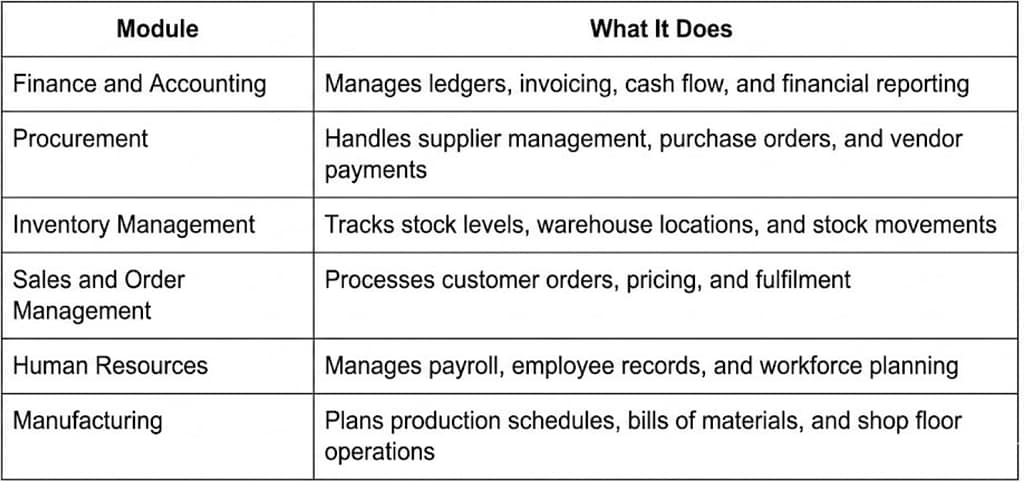
How ERP Connects Business Departments
The core idea of ERP is the “single source of truth.” There are no different spreadsheets or different software for each department, everything is in one system. If a stock count is adjusted in the warehouse, the finance team immediately sees the effect. Procurement issues Purchase order Inventory gets updated No phone call. The shared data layer reduces errors and speeds up decisions, providing leadership with a real-time, accurate view of the business.
Types of ERP Systems
On-Premise ERP
On-premise ERP is installed and hosted on a company’s own servers and infrastructure. The software is licenced to the company and the company is responsible for the hardware maintenance, updates and security. This model gives the most control and customisation, but requires a high upfront investment in hardwarex and IT staff. Most prevalent in large enterprises with dedicated technology teams .
Cloud ERP
Cloud ERP ( aka SaaS) is hosted by the vendor on their servers and accessed through the Internet, usually for a monthly or annual fee. Providers handle the infrastructure and upgrades, reducing upfront costs and letting companies deploy faster. For small and mid-sized businesses, the best model for availability and scalability is Cloud ERP systems. Most of the modern ERP vendors (NetSuite, Microsoft Dynamics 365) are cloud first these days.
Industry-specific ERP
Industry-specific ERP systems are designed to follow the workflows of a given industry, whether that’s food and beverage, construction, or healthcare. These systems come pre-configured with the relevant compliance requirements, reporting structures and operational logic for that industry, rather than having to heavily customise a generic platform. This is could include things like batch tracking and expiry date management for food businesses, out of the box.
Hybrid ERP
Hybrid ERP combines on-premise and cloud deployments. For instance, a company could deploy its core financial modules on local servers for data security, but use cloud applications to access other functions like sales or human resources. This is often the case for companies that are transitioning from legacy on-premise systems to cloud infrastructure, or for companies that operate in regions with different data residency regulations.
ERP Examples: Popular ERP Systems
SAP
SAP is the largest ERP vendor in the world, with its flagship product SAP S/4HANA serving large enterprises across manufacturing, retail, and logistics. SAP is known for its depth and customizability, but implementations are lengthy and expensive, often requiring specialist consultants and multi-year rollout timelines. It is most suited to large organizations with complex, global operations.
Oracle NetSuite
Oracle NetSuite is a cloud-based ERP solution that many growing mid-market companies rely on. It’s an all-in-one that handles financials, inventory, order management and CRM. Plus, it’s popular with e-commerce and wholesale businesses. NetSuite is more accessible than SAP, but it still carries steep licencing and implementation costs that can run into six figures.
Dynamics 365 (Microsoft)
Microsoft Dynamics 365 is a modular ERP and CRM platform that integrates with the wider Microsoft ecosystem, including Excel, Teams and Power BI. It gives companies more flexibility to buy individual modules rather than the whole suite. Good for mid-to-large businesses already in the Microsoft environment that want tight integration across productivity tools.
Odoo is
Odoo is an open source ERP platform that offers a large number of modules including accounting, inventory, purchasing and e-commerce. It’s less expensive than SAP or NetSuite, thanks to its modular pricing structure and open-source foundation. It has a strong community of developers. Odoo is popular with small and medium businesses that need flexibility but still have technical resources for customisation.
If you are comparing specialized distribution tools against broader ERP platforms, see our detailed breakdown on the Cin7 alternative for food wholesale page.
ERP vs Specialised Distribution Software: What Food Wholesalers Should Know
Why Traditional ERP Falls Short for Food Trade
Traditional ERP systems were designed for the needs of large manufacturing or retail enterprises. For food wholesalers, this mismatch creates real operational problems.
First, implementation timelines are a serious obstacle. A typical SAP or NetSuite deployment for a mid-sized business takes six to twelve months before it is fully operational. During that window, a food distribution business is managing live orders, perishable stock, and supplier relationships without the system it is paying for.
Second, the cost is prohibitive for most SMBs. Between licensing, implementation consultants, customization, and training, a full ERP rollout can run into hundreds of thousands of dollars before the first invoice is processed.
Third, and most critically, generic ERP modules were not built with food trade in mind. Features like First Expiry First Out (FEFO) inventory rotation, perishable batch tracking, and cross-border food compliance are typically not native to standard ERP systems. They need either expensive third party add-ons or custom development, neither of which is fast or easy.
What food wholesalers actually need
What food wholesalers really need is a purpose-built distribution platform that fits their specific workflow without the burden of a full ERP implementation.
That means native batch tracking and expiry management, so FEFO rotation is done automatically, not by spreadsheet. That means AI-based demand forecasting that considers seasonality and supplier lead times for particular food categories. That is mobile-first order management that works the way a food sales rep actually works – taking orders on the go and sending invoices through WhatsApp.
This is exactly the workflow for which OrderIT, Prosessed AI’s order management product, is built. It starts with the way food wholesale orders really flow, from the sales call to the delivery confirmation, rather than bolting on food-specific features to a generic ERP.
The essential difference: traditional ERP demands that food companies modify their business processes to adapt to the software. Business adapts to a dedicated distribution platform.
Benefits of ERP Systems (and Their Limitations)
ERP Benefits
Data by department. The single database model breaks down data silos and guarantees that everyone on the team is using the same data. This limits errors that arise from finance, warehouse and sales teams holding their own separate records.
Improved reporting and visibility. Because all transactions go through a single system, leadership benefits from real-time reporting across the whole business without the need to manually pull data from multiple sources.
Process automaton ERP systems can automate routine tasks like purchase order creation, invoice matching and triggers for stock replenishment, thereby reducing manual workload and human error.
Scalability. A good ERP can grow with the business adding new product lines, warehouses and order volume without replacing the system.
Typical problems and disadvantages of ERP
Expensive to implement. Beyond the licence fees, there are costs for consultants, custom development, data migration and staff training for ERP projects. Smaller companies often find that they are paying more than they expected.
Long deployments. Most traditional ERP implementations take six to 12 months. That lag has a direct impact on the operations of a fast-moving food distribution company.
overengineering Complexity . Most ERP systems have capabilities that small businesses would never use. Managing and paying for that complexity adds overhead but no value.
Overhead on change mgmt. People need to change the way they work for ERP implementations. Not always a little. Poor adoption is one of the top-cited reasons why ERP projects fail to deliver the expected return on investment.
ERP for Small and Medium Food Businesses: Is It Worth It?
For most small and medium food wholesalers, a full ERP system is the wrong tool for the job. The implementation timelines, costs, and complexity that come with platforms like SAP or NetSuite were designed for large enterprises with dedicated IT departments and multi-year technology budgets.
An SMB food wholesaler does not need an HR module or a manufacturing planning engine. It needs accurate inventory, reliable order processing, supplier procurement, and demand forecasting that works for perishable goods. Implementing a full ERP to get those capabilities is like hiring an entire accounts department when what you needed was one good bookkeeper.
What the category of food wholesale SMBs actually needs is a lean, purpose-built distribution platform that deploys in weeks, costs a fraction of enterprise ERP, and is already configured for the compliance and operational requirements of food trade. ProcurePro by Prosessed AI is built on exactly this principle, giving food wholesalers native procurement capabilities without the ERP overhead.
ERP Frequently Asked Questions
What is ERP?
ERP means Enterprise Resource Planning. It is a nod to integrated business management software that links core business functions like finance, inventory, procurement, HR and sales onto a single platform.
What’s the Difference Between ERP and CRM?
ERP and CRM have different main purposes, but there is some overlap. ERP manages internal business processes like finance, inventory, supply chain, and production. CRM, or Customer Relationship Management software, is all about managing external relationships with customers, including sales pipelines, contact history and marketing activity. Many ERP platforms today have a CRM module, and some vendors offer both as part of an integrated suite.
Is QuickBooks an ERP software?
QuickBooks is NOT an Enterprise Resource Planning (ERP) system. This is accounting software that does bookkeeping, invoicing and basic financial reporting. It connects with some inventory and payroll tools, but doesn’t have the cross functional integration of a real ERP. Businesses that are outgrowing QuickBooks tend to look at cloud ERP platforms or industry-specific distribution software.
What ERP is best for food distribution?
Traditional ERP systems like SAP or NetSuite are more of a best fit as compared to most food distribution businesses. They are expensive, slow to deploy and lack native food-specific features. Specialised distribution platforms for food wholesalers, like Prosessed AI, provide the same basic features that any distribution platform would have – inventory management, procurement, and order processing – but also come with features that are unique to food, like FEFO batch tracking and AI demand forecasting, and at a fraction of the cost and implementation time.
How much does an ERP system cost?
ERP costs vary widely by platform and business size. SAP implementations for mid-sized businesses range from $150,000 to $1 million+ with consulting and customisation included. Oracle NetSuite pricing begins at roughly $30,000 per year for smaller companies but quickly scales depending on the number of users and modules. Odoo is cheaper but customisation still requires development investment. Prosessed AI is built for a specific purpose and is priced at a fraction of those costs. See Prosessed AI pricing for a direct comparison.
Why Food Wholesalers Choose Prosessed AI Over Traditional ERP
Food wholesalers evaluating ERP consistently run into the same wall: the platforms built for large enterprise manufacturing are not built for the pace, perishability, and compliance requirements of food distribution.
Prosessed AI was built from the ground up for this gap. It deploys in weeks, not months, so businesses are not running a live operation on spreadsheets while waiting for an ERP to go live. Its features are food-native by design, covering FEFO inventory rotation, perishable batch tracking, WhatsApp invoicing for field sales teams, and AI-powered demand forecasting calibrated for seasonal and perishable product categories.
Where SAP or NetSuite implementations routinely run into six figures and require specialist consultants, Prosessed AI is a lean platform priced for the real cost structure of food wholesale SMBs. There are no generic modules to configure around and no functionality you will never use. Every feature maps to a real workflow in a food distribution business.
If you are evaluating ERP options for your food wholesale operation, the most important question is not which ERP to choose. It is whether ERP is the right category of tool at all.